How to tell if a Shopify app niche is already saturated (a repeatable method)

How to tell if a Shopify app niche is already saturated (a repeatable method)
To tell if a Shopify app niche is saturated, do not count the apps and stop there. Run four quick reads in order: how many living apps already serve it, how concentrated the reviews are at the top, whether Shopify or a free first party already owns the job, and whether merchants actually pay. A niche is only truly closed when several of those line up against you. The most common mistake is calling a niche "too crowded" off the app count alone, when the real question is whether a new app can get noticed and get paid.
Why "saturated" is the wrong word
Most builders use "saturated" to mean "there are already a lot of apps here." That definition will talk you out of good niches and into bad ones. What you actually care about is winnability: can a new, good app climb the ranking, get installs, and charge money. A niche can be packed and winnable, or near-empty and hopeless. The app count by itself tells you almost nothing about which.
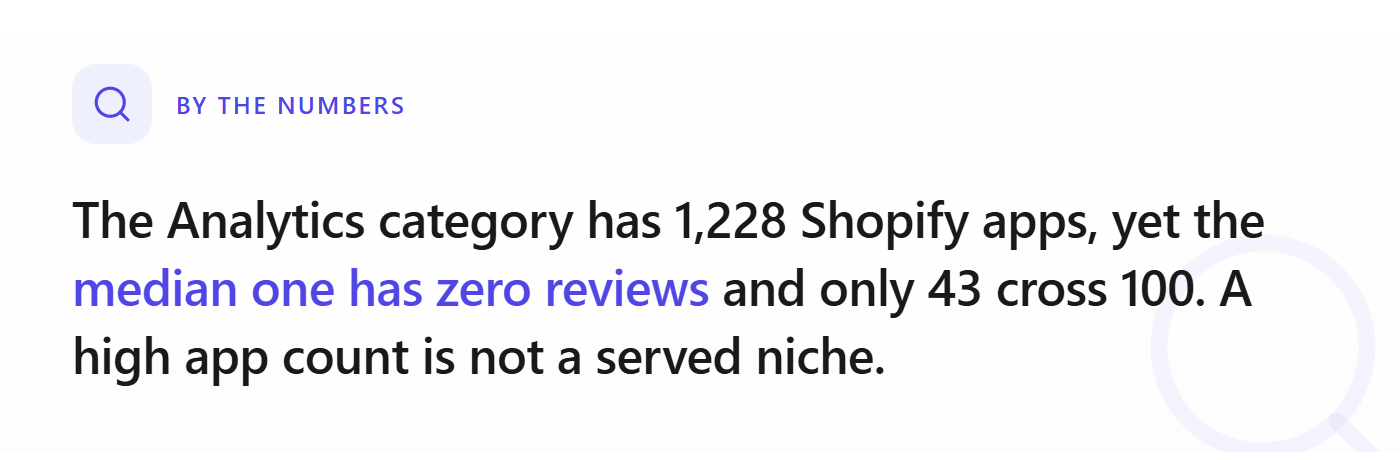
Here is the trap, with real numbers from our scrape of the live store. Analytics is the single most crowded category: 1,228 live apps. It looks impossible. But of those 1,228 apps, the median one has zero reviews, 79.6% have fewer than five, and only 43 apps cross 100 reviews at all. The biggest app in the category holds just 8.4% of the category's reviews. So the "crowd" is mostly apps nobody installs, and there is no single dominant leader. That is a different, more nuanced picture than "1,228, run away."
The point is not that Analytics is a good bet. It is that the app count alone pointed you at the wrong conclusion, and you need a method that does not.
The four reads, in order
Run these on any niche, every time, in this order. The order matters because the early reads can kill a niche before you bother with the later ones.
Read 1: the first-party wall (do this first)
Before counting anything, check whether Shopify itself or a free first-party Shopify app already does the job in the admin. Shopify ships native bundles, native discounts, native B2B, native markets, and the native list grows every year. If the core of your idea is now a checkbox merchants already have, the paid market around it is shrinking, and a crowded-looking listing is a lagging indicator of a market that is actually closing.
The same wall shows up as platform limits. Some things an app simply cannot do, or can only do on Shopify Plus. Building toward that wall wastes months. Verify Shopify permits your approach before you design around it. If the first read fails, you can stop here.
Read 2: living apps, not total apps
Now count, but count the right thing. The listing total includes a long tail of dead apps: no recent reviews, last update years ago, support inbox abandoned. They inflate the count without competing for anything. What you want is the number of living competitors: apps with recent reviews and recent updates.
A practical way to do it by hand: sort the niche by reviews, open the top fifteen or twenty, and check the most recent review date and the "last updated" date on each listing. The ones still getting reviews this quarter and shipping updates are the real field. A niche that shows forty results but has six living apps is not crowded. A niche with twelve results that are all active and growing is.
Read 3: review concentration, the read that decides it
This is the one that actually tells you whether the door is open. Reviews are the closest public proxy we have for installs, because Shopify hides install counts. So you measure how the reviews are spread.
Add up the reviews of the top apps in the niche, then look at what share the single biggest app holds:
- One app holds 40% or more of the niche's reviews: there is a king. It owns the search ranking and the social proof, and a new app starts from zero against an entrenched incumbent. Treat the niche as closed unless you have a sharp angle the king cannot copy.
- The top apps are clustered, no one above roughly a quarter: there is no king yet. This is the shape you want. Real demand, attention spread thin enough that a better app can climb.
- Almost no reviews anywhere in the niche: not an opening, a warning. It usually means little real demand, not an undiscovered goldmine. Pair this read with Read 4 before you get excited.
Concentration beats count every time. Forty apps with no leader is more winnable than eight apps where one holds 60% of the reviews.
Read 4: do merchants actually pay
Installs are not the goal, paying installs are. A niche can have demand and still be a bad business if merchants have been trained to expect the thing for free. Two checks: do the established, living apps in the niche actually charge, or is it a sea of free apps with one paid outlier? And what is the median paid price among the real apps? That median is roughly your price ceiling on day one, before you have a brand. If the niche sits at 9 to 15 dollars a month, you are not launching at 49.
Turning the four reads into one answer
You are not scoring this to three decimal places. You are looking for how many reads line up against you:
- First-party wall: does Shopify or a free first party already own the job? If yes, usually stop.
- Living apps: how many active, growing competitors are really there, ignoring the dead tail?
- Review concentration: is there a king (one app above ~40% of reviews), or is the top of the niche still open?
- Willingness to pay: do the real apps charge, and what is the median price?
A niche is genuinely saturated when there is a king AND a deep living field AND merchants already have a free or first-party option. A niche is open when the living field is thin, no single app owns the reviews, and merchants clearly pay for the thing. Most niches sit in between, and that middle is exactly where the read is worth doing carefully rather than guessing.
If you want the broader version of this check across a whole idea, not just the saturation question, we walk through it in how to validate a Shopify app idea before you write any code. And if you would rather see which categories are already packed at the top, we list them in the most saturated Shopify app categories in 2026.
The part that is slow by hand
Running these four reads on one niche is an afternoon. Running them honestly across the five or six niches you are actually choosing between is a week, and the math in Read 2 and Read 3 (counting living apps, summing reviews, working out concentration and the median price) is exactly the kind of thing that is easy to eyeball wrong. Miscount the living field or misread the concentration and you talk yourself into the closed niche and out of the open one.
That is why we built the read into a tool. The MetricHQ Market Validator runs all four reads against the live App Store data for any niche you type in: how crowded it really is once the dead apps drop out, how concentrated the reviews are at the top, what share of apps charge and at what median price, and a projection of what it would take to break even at a given ad budget. It is the same method above, computed against the whole dataset instead of fifteen tabs you opened by hand.
Run the four reads on your niche in one pass
We scraped every app on the Shopify App Store. Check any niche for saturation, demand, and the gaps worth building, in seconds, before you write a line of code.
The method is the point. Run it in your head on the next idea you get excited about, and most of the time the first-party wall or the review concentration will give you a clear answer before you write a line of code. When it does not, that is the niche worth checking properly.