How much does it cost to build a Shopify app in 2026?

How much does it cost to build a Shopify app in 2026?
A basic Shopify app costs roughly $5,000 to $15,000 to build, and a genuinely complex one (real billing, multiple integrations, background jobs, support tooling) runs $30,000 and up. If you write the code yourself, the cash cost can be close to zero plus a one-time $19 fee. But the build is the cheap part. The expensive part, the part almost no quote includes, is getting anyone to install it.
What "cost to build a Shopify app" actually means
There are three different questions hiding inside that one, and they have very different answers.
1. A private or custom app for one store. This is an internal tool for a single merchant, never listed publicly. It is the cheapest path because there is no App Store review, no public billing, no support load. You do not even need the paid registration: Shopify only charges the App Store fee when you distribute publicly (Shopify Partners glossary).
2. A public app you list in the App Store. This is a product. It needs an onboarding flow, a billing integration, GDPR webhooks, a support inbox, and it has to survive Shopify's app review. The build is bigger and the work does not stop at launch.
3. The app you actually maintain for a year. This is the number that surprises people. The code is a one-time spend; merchants, support tickets, and Shopify platform changes are forever.
Most "cost to build a Shopify app" quotes only answer question 1 or 2, then go quiet on question 3. That is where budgets blow up.
The real ranges in 2026 (with sources)
Here is what the market actually charges, pulled from current agency and developer pricing guides. Treat these as ballparks; your number moves with complexity and who builds it.
Typical Shopify app build cost by type (2026)
Illustrative ranges from current agency and developer pricing guides; midpoints shown. Your number moves with complexity and who builds it.
- Simple public app (one clear job, light Admin UI, one or two API surfaces): roughly $5,000 to $15,000. (Shopify app development cost guide, ShopExperts)
- Substantial app (multiple features, several integrations, real billing): $15,000 to $60,000.
- Complex / MVP of an ambitious public app: $30,000 to $150,000+, depending on integrations and compliance.
- Hourly rates: about $100 to $400/hour, swinging with geography, seniority, and agency vs freelancer. (Folio3 estimate)
API integrations alone are commonly budgeted at $2,000 to $15,000 because they are time-intensive, and compliance-heavy apps add $5,000 to $20,000 for security, logging, and legal review. Those line items are easy to forget in a first estimate and they are real.
My honest read: the headline build number is the least interesting figure on this page. A simple app at $8,000 that nobody installs cost you $8,000. A simple app at $8,000 in a niche where merchants are actively searching for it can pay that back in a couple of months. Same code, same invoice, completely different outcome, and the difference has nothing to do with the build.
DIY vs agency: the honest tradeoff
If you can write the code, building it yourself is by far the cheapest path in cash. Shopify's CLI scaffolds an embedded app, the dev tooling is free, and unlimited development stores cost nothing. Your real cost is time, and the trap is that the framework makes the first 80% feel done while billing, edge cases, App Store review, and webhooks are the slow 20%.
Hiring out buys you speed and a finished, reviewable product, at the ranges above. It does not buy you demand. An agency will happily build whatever you brief, including an app for a market that does not want one.
A middle path a lot of solo founders take: build the first version yourself to prove people want it, then pay to harden it once installs are coming in. That sequence keeps your largest spend behind the one fact that actually de-risks the project, which is real demand.
What Shopify itself charges (the small part)
People expect Shopify's cut to be the scary number. It is not.
- One-time $19 App Store registration fee to distribute publicly. Private and single-merchant custom apps skip it entirely. (Shopify Partners glossary)
- You keep 100% of your first $1,000,000 in gross app revenue per year, then 85% above that. Billing carries a 2.9% processing fee. (Shopify revenue share docs)
For almost every new app, Shopify's platform cost rounds to a rounding error. If revenue share is the number keeping you up at night, you are worrying about the wrong end of the project.
The cost nobody quotes: distribution
Here is the part that matters. Building the app is a solved, priced problem. Getting it installed is not, and that is where the money and the months actually go.
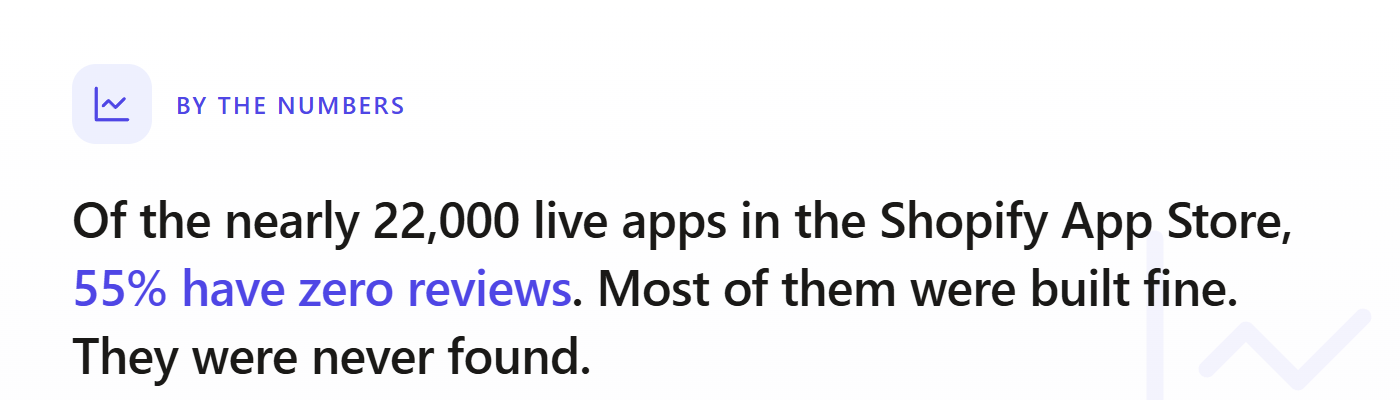
Look at the store as it stands: nearly 22,000 live apps, and more than half of them have zero reviews. Zero reviews is a proxy for zero (or near-zero) installs. A huge share of those apps were built competently. They simply launched into a category nobody was searching, or against incumbents who own the search results, and never got found.
So the cost that decides whether your build pays off is not in the invoice. It is:
- App Store SEO and listing quality (your icon, title, and keywords decide if you ever appear in a merchant's search).
- Reviews, which are the flywheel: no reviews means no ranking means no installs means no reviews.
- Paid acquisition, if the category is competitive enough that organic discovery alone will not move you.
This is why the order of operations is the whole game. Validate that a real, underserved demand exists before you commission code. The cheapest possible app in a dead category is still a waste. A mid-priced app in a category with real searches and beatable incumbents is the one that returns its build cost.
How to spend your money in the right order
- Pick a market with real, current demand and beatable competition. Not "an app idea you like," a market the data says merchants want and is not already locked up.
- Sanity-check the economics. What can you charge, how many installs to break even, how much would paid acquisition cost in that category?
- Then build, starting as cheap as you credibly can (yourself, or a tight MVP brief).
- Then spend on distribution, which is where the recurring money goes.
We wrote a fuller version of step 1 in how to validate a Shopify app idea before you write any code, and step 2 leans on knowing your category: see the most saturated Shopify app categories in 2026. If you want the wider picture of how crowded the store has gotten, we scraped the whole market.
See the read before you spend
Before any of those build numbers matter, you want one thing: evidence that a market will actually install what you make. That is exactly what the MetricHQ Market Validator does. You give it a category, your planned price, and your budget, and it reads the live App Store data to tell you how crowded the niche is, how beatable the leaders are on rating, what share of apps even charge, and roughly what it would cost in ad spend to compete, with a real revenue-vs-spend projection and break-even.
That projection is the figure your build invoice cannot give you: not what the app costs to make, but whether it is likely to make the money back.
Know if the market will install it, before you pay to build it
We scraped every app on the Shopify App Store. Check any niche for saturation, demand, and the gaps worth building, in seconds, before you write a line of code.