How to get your first 100 Shopify app installs

How to get your first 100 Shopify app installs
Getting your first 100 Shopify app installs comes down to three things done well: a listing that actually ranks for the searches merchants type, a deliberate push to earn your first reviews, and direct outreach to merchants who have the exact problem you solve. The store will not hand you installs because your app is good. The default outcome for a new app is zero, and most apps never escape it. The first 100 installs are the ones you go and get by hand, before any algorithm decides you exist.
The cold-start problem is real, and it is the default
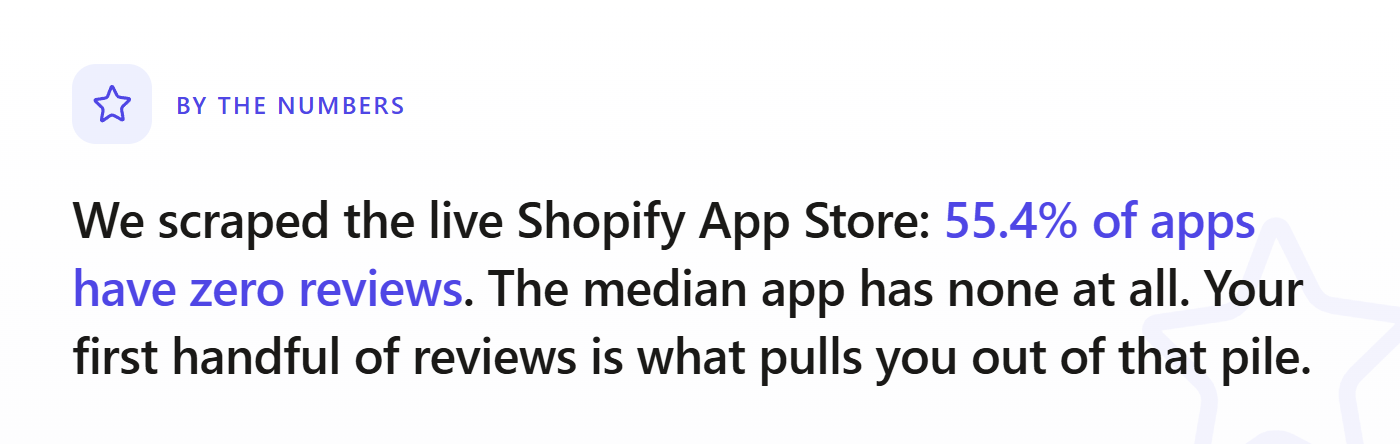
Most new apps never get traction. We scraped the live Shopify App Store, 21,749 apps, and 55.4% of them have zero reviews. Three quarters have fewer than five. The median app has none at all. Reviews are the closest public proxy we have for installs, so that zero-review pile is mostly apps nobody is using.
That is the cold start. A brand-new app has no reviews, no install history, and no ranking signal, so the store has no reason to surface it. Merchants searching the App Store see the apps with social proof, which are not you. Nobody installs because nobody installs. The whole job of your first 100 installs is to break that loop manually, because the algorithm will not break it for you until you have given it something to work with.
The good news hiding in that number: the bar to stand out is low. You do not need to beat the category leader to get your first hundred. You need to look more alive than the half of the store that is dead, and that is a much smaller ask.
Step 1: make the listing rank for what merchants actually search
Before outreach, fix the thing that works while you sleep. Most new apps lose here without realizing it, because they write the listing for themselves instead of for the search box.
Shopify ranks apps mainly on relevance to what a merchant typed, plus how merchants behave after they search. Their own developer changelog says they fold in behavioral data (which results people click, install, and keep) and that keyword stuffing now has less impact than it used to (Shopify dev changelog). So the listing has two jobs: match real search terms, and convert the click into an install once you are found.
Concretely:
- Lead with the job, not the brand. Merchants search for the problem ("back in stock alerts", "volume discounts", "order limit"), almost never your app's name. Put the highest-intent phrase in your app title and tagline.
- Use the search terms field. The app submission form has a dedicated search terms field. Fill it with the exact phrases merchants type, not clever synonyms. This is the one ranking lever that works before you have any traction.
- Write key benefits for skimming. The first two benefit lines are what a merchant reads before deciding. Make them concrete outcomes, not adjectives.
- Earn the click-through. Your icon and first screenshot decide whether a merchant clicks at all. A clear icon and a screenshot that shows the actual result beat a polished but vague one.
This is the discipline of a real app-store listing, and it is the same market-reading skill you should have used before writing a line of code. If you have not done that read yet, do it first: how to validate a Shopify app idea before you write any code.
Step 2: engineer your first reviews on purpose
Reviews are the single biggest thing standing between you and the rest of the store. The median app has zero, so going from zero to even five genuine reviews is a real jump in both social proof and ranking signal. Shopify weights recent review activity, so a small cluster of fresh reviews in your first weeks does more than the same reviews spread over a year.
You cannot buy or fake these, and you should not want to. What works:
- Ask at the moment the app delivers value. Not on install. The right moment is right after the merchant sees the thing your app does, the first time a bundle shows up correctly or the first back-in-stock email sends. An in-app prompt timed to that beats a generic email.
- Make the ask personal for the first dozen. For your first ten or twenty merchants, you should know each one by name. A short, human message from the founder asking how it is going (and, if it is going well, for an honest review) converts far better than any automated nudge.
- Fix the unhappy ones fast. Early one-star reviews are heavy when you have three total. Respond to every review publicly, and reach out privately to fix the problem. A merchant whose issue you solved often updates the review.
A genuine opinion here: do not chase a 5.0. A 4.8 with twenty reviews reads as real and beats a perfect 5.0 with three. Merchants trust a little imperfection, and the algorithm trusts volume and recency.
Step 3: go get the installs by hand
This is the part most builders skip, and it is the part that actually produces the first hundred. Organic discovery does not exist yet for you, so you create demand directly.
Direct outreach to merchants who have the problem. Find stores that visibly have the exact pain your app solves. If you built a back-in-stock app, find stores with sold-out products and no waitlist. If you built an order-limit app, find stores doing wholesale or limited drops. Reach out as a builder offering a fix, not a salesperson. A specific message ("I noticed your bestseller is sold out with no notify-me option, my app adds one in two minutes") lands because it is true and useful.
Show up where your merchants already are. The Shopify Community forums, relevant subreddits, niche Facebook and Discord groups for store owners in your vertical. Answer the questions your app addresses, helpfully and without pitching every time. People install apps from builders they have seen being useful.
Offer the first cohort something real. Early access, a founder who answers within the hour, a longer trial, or help with setup. You are trading attention for feedback. The first 100 merchants are worth more as a feedback loop than as revenue, so price the relationship accordingly.
Partner sideways. A theme developer, an agency, or a complementary app serving the same merchants can send you your first real users faster than any ad. One agency that recommends you to its clients can be a quarter of your first hundred.
None of this scales, and that is the point. The first 100 installs are bought with founder time, one merchant at a time, and the data you collect doing it tells you whether the next 1,000 are even there.
Pick a niche where 100 installs is reachable at all
Here is the trap. You can do all three steps perfectly and still stall, because some categories are structurally closed to a newcomer. If a first-party Shopify app owns the category, organic discovery routes merchants to it by default, and no amount of outreach fixes a market where the demand is already captured.
The obviously crowded categories are easy to name: analytics, reviews, email and SMS, upsell. Everyone knows those are packed. The harder and more useful question is whether the leaders in your specific niche are beatable, and whether the category is busy-but-winnable or genuinely walled. That read (app count, how concentrated the reviews are at the top, whether merchants actually pay) is exactly what decides if your first 100 installs are a grind or an impossible ask.
The most crowded Shopify app categories, by live app count
Live App Store snapshot, June 2026 scrape (21,749 apps). The obvious crowded categories, not the open ones.
A bar of the most crowded categories proves the obvious half. It does not tell you where the open lanes are, because the open lanes are rarely the obvious ones and they change month to month. For more on reading saturation properly, see the most saturated Shopify app categories in 2026.
If you have already shipped and you are grinding for those first installs in a category that turns out to be walled, that is the expensive version of skipping the market read. Better to know your niche's real shape before you commit the next three months to outreach.
A note on the Built for Shopify badge
Once you have your footing, the Built for Shopify badge is worth pursuing. Shopify reports apps that earn it see roughly +14% installs and get ranked higher in search than other apps (revenue share and program docs). But it is a later-stage lever, not a cold-start one. You earn it by being a quality, established app, which means it helps install 200 onward, not install 1. Get the first hundred the manual way first.
The validator reads the live App Store data for any niche: how crowded it is, how beatable the leaders are, whether merchants actually pay, and what a realistic install trajectory looks like. It is the fastest way to know, before you pour founder hours into outreach, whether your first 100 installs are sitting there waiting or whether the market is already closed.
See if your niche can even get to 100 installs
We scraped every app on the Shopify App Store. Check any niche for saturation, demand, and the gaps worth building, in seconds, before you write a line of code.
The first 100 installs are not a marketing problem you solve later. They are the proof that a real, reachable market exists, and you build that proof one merchant at a time. Get the listing right, earn reviews at the moment of value, and go talk to merchants who have the exact problem you fixed. Just make sure the niche you are grinding in has room for one more app first.