Free vs paid Shopify apps: what 21,749 listings reveal

Just under half of Shopify apps lead with a free plan: 43.8% of the 21,749 live apps in the store offer one, which means a slim majority charge from the first install. So "should my app be free or paid" has no single right answer. The honest version is that it depends on your category and what you want the free tier to do for you, and the data shows the split swinging from roughly a third of apps to nearly three quarters depending on where you build.
What "43.8% free" actually means
The number comes from our June 2026 scrape of every live listing on the Shopify App Store: 21,749 apps, of which 9,517 expose a free plan or a permanently free tier. That is not the same as 43.8% being free-to-use forever. A "free plan" on Shopify usually means a real free tier inside an otherwise paid app, and the line between "free plan" and "free trial" gets blurry on the listing itself.
The useful read is the inverse: a slim majority of apps, 56.2%, charge from the moment a merchant installs. That is worth sitting with if you assumed free was the default. It is common, but it is not the norm, and the apps that do charge from install are not all failing for it.
The store-wide average lies. The category is the real signal
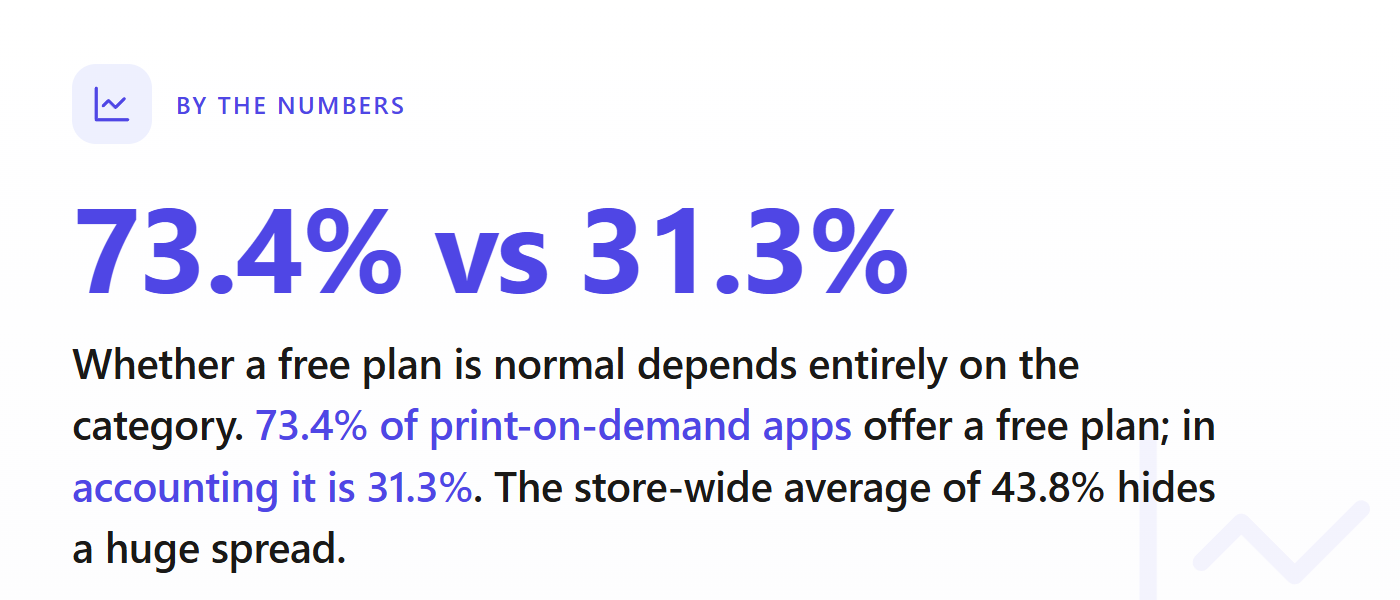
Here is where the headline number stops being useful. When you split the 43.8% by category, the spread is enormous:
- Print on demand: 73.4% free (240 of 327 apps)
- Image editing: 66.1% free
- Dropshipping: 57.4% free
- SEO: 55.9% free
- Product reviews: 53.7% free
- Shipping: 49.9% free
- Discounts: 42.3% free
- Analytics: 37.5% free (460 of 1,228, the largest category in the store)
- Inventory sync: 33.5% free
- Accounting: 31.3% free
Share of apps offering a free plan, by category
Source: MetricHQ scrape of the Shopify App Store (June 2026). Percent of live apps in each category that offer a free plan.
The pattern is not random. Categories where the merchant has zero risk in trying you, and where you can earn money on usage later, lean heavily free. Print on demand makes money when an order ships, so the app itself is free to install and the revenue comes from fulfilment. Accounting and inventory sync are the opposite: the value is obvious, the data is sensitive, switching is painful, and merchants expect to pay. Charging from install in those categories is normal, not brave.
The builder's takeaway: do not benchmark your model against "Shopify apps" as a whole. Benchmark it against your category. If you are building an SEO app and shipping a paid-only plan, you are swimming against 55.9% of your competitors who let merchants in for free. That is a fine choice, but make it knowing the current.
What leading with free actually buys you
Free is not a pricing strategy. It is a distribution tactic, and it does two specific jobs.
It buys installs and reviews. This is the real reason free is so common. The App Store ranks heavily on installs and review count, and a price tag is the biggest friction at the install step. In our data, free apps carry a slightly higher median review count (7 versus 5 for paid) and are more than twice as likely to hold the Built for Shopify badge: 10.2% of free apps have it versus 4.3% of paid apps. Free apps accumulate the social proof that the algorithm rewards, faster.
It lowers your support and refund noise, but raises your volume. A free tier brings in merchants who will never pay and never would have. That is fine if support is cheap to serve. It is a problem if every free install opens a ticket.
What free does NOT buy you is revenue, and this is where most free-first apps stall. A free tier only works if there is a real, well-placed paid step: a limit a growing store actually hits (order volume, number of products, team seats), or a feature a serious merchant genuinely needs. If your free tier does everything, you have not built a free plan, you have built a free app, and you will fund it out of pocket.
When paid-from-install is the smarter call
Charging from the first install is the right move more often than founders think, especially solo founders who cannot afford to subsidise thousands of non-paying merchants.
Lead paid when:
- Your category expects it. Accounting, ERP, inventory sync, anything finance-adjacent. Merchants in these categories are evaluating trust, not hunting for free. A price signals you are a real, supported product.
- Each install costs you money to serve. If your app does heavy processing, calls a paid API, or needs hands-on onboarding, free installs are a direct loss.
- You want fewer, better customers. A 7-day or 14-day free trial gets you the "try before you buy" benefit without the permanent free-tier overhead. The merchant tests it, then converts or churns. You are not carrying them forever.
A free trial is not the same as a free plan, and the distinction matters for your unit economics. A trial has an end date; a free plan does not. If you want low-friction trial without the long tail of freeloaders, a trial is usually the cleaner choice for a small team.
How to decide for your specific app
Skip the generic advice and read your own category. The method is the same one we use:
- Pull the free-versus-paid split for your exact category, not the store average. 43.8% is meaningless for your decision. The number for your niche is the one that tells you what merchants there expect.
- Look at what the top apps in your category do, and whether free is winning. If the leaders are free with a clear paid step, free is the path of least resistance. If the leaders charge from install and still dominate, the category will pay.
- Find the paid trigger before you ship free. Decide the exact limit or feature that flips a merchant from free to paid, and make sure a growing store hits it within weeks, not years.
- Pressure-test the revenue, not the installs. Free will get you installs. Model the conversion to paid honestly, because that is the number that funds the app.
If you are still at the idea stage, this decision is part of a bigger question: is the category even worth entering, and how beatable are the apps already there. We wrote a full method for that in how to validate a Shopify app idea before you write any code, and a look at the most saturated Shopify app categories in 2026 for where the crowding is worst. Pricing model is a downstream choice; pick the right pond first.
See the read for your niche
The free-versus-paid split is one of several signals you want before committing months to a build: category saturation, how the demand is trending, how beatable the current leaders are on rating, and whether the niche actually monetises. The Market Validator pulls all of that for any niche from the same full Shopify App Store scrape this article is built on.
Should your Shopify app be free or paid? Check your category first.
We scraped every app on the Shopify App Store. Check any niche for saturation, demand, and the gaps worth building, in seconds, before you write a line of code.
The 43.8% average is a fine bit of trivia. The number that should drive your pricing is the one for your category, next to how crowded and how beatable that category is. Read those together before you decide.