Is Shopify App Development Booming? We Scraped the Whole Market

Yes, building Shopify apps is still worth it, and the App Store is bigger and busier than most people guess. We scraped the entire Shopify App Store and found 21,749 apps that publish a launch date. The store is large, and it is still adding hundreds of new apps every month. Exactly how fast launches have grown over the long run is harder to pin down than a single multiplier suggests, but the direction is not in doubt: this is an active, expanding marketplace, not a dying one.
How many Shopify apps are there in 2026?
We pulled the full Shopify App Store and counted 21,749 apps that carry a public launch date. That last part matters. This is not a survey or a press estimate. It is the actual marketplace, scraped app by app, so the store size below is the population, not a guess scaled up from a sample.
The headline most builders care about is the pace, not the total. Here is roughly how many new apps have launched each month over the last couple of years:
New Shopify apps launched per month (live apps only)
Source: MetricHQ scrape of the Shopify App Store, May 2024 to March 2026. Counts only apps that are live today, so older months are undercounted (delisted apps are gone); the latest month is dropped because re-stamped launch dates inflate it. Read this as direction, not a precise growth rate.
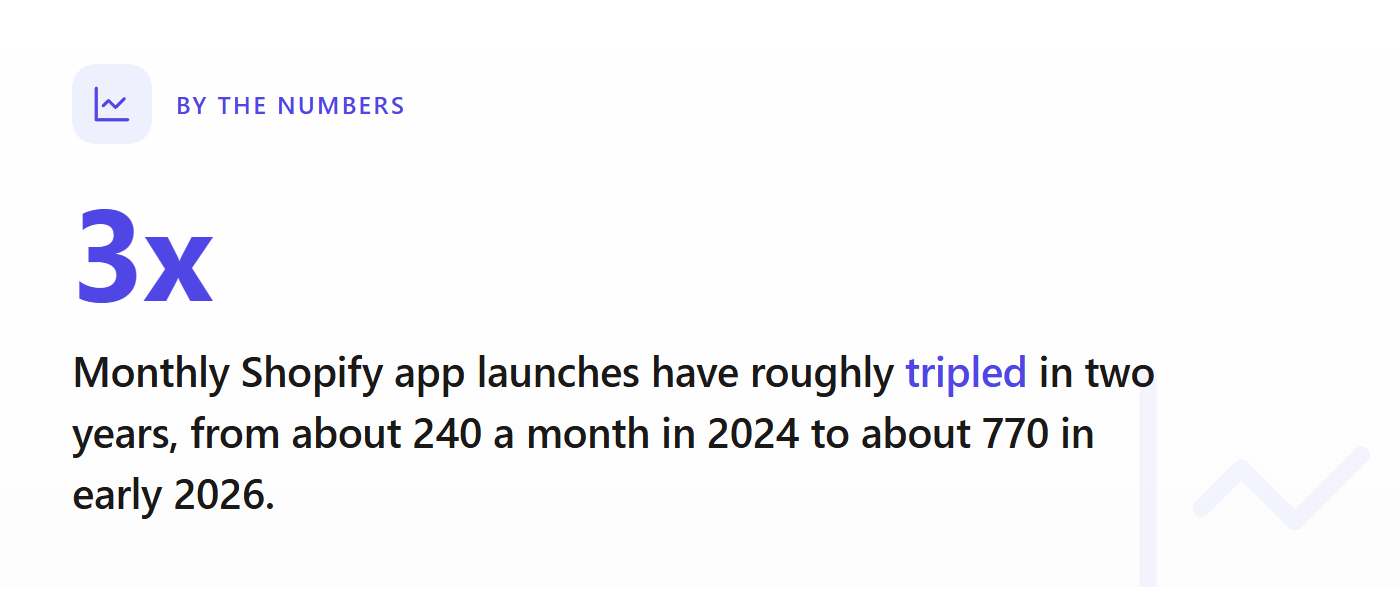
The shape is what matters more than any single number. Through most of 2024 the store added somewhere around 230 to 280 new apps a month. Through 2025 and into 2026 the monthly count sits noticeably higher, in the several-hundreds. New apps are clearly arriving faster than they were two years ago. We would not put a precise multiplier on that, and the next section explains why a number like "tripled" is easy to overstate from data like this.
How we counted, and why we will not claim a precise growth rate
One honest caveat, because it changes how you should read that curve. Our scrape is a snapshot of apps that are live right now. It cannot see apps that launched, struggled, and were delisted, and older months lose more apps to that attrition than recent ones. That alone makes any "launches over time" line look steeper than reality, because the past is quietly undercounted. On top of that, the most recent month or two are inflated by Shopify re-stamping launch dates, so the freshest bar is not a clean count of genuinely new apps. We drop the latest month for that reason, and we still treat the early-2026 figures as a soft ceiling rather than a hard fact. So we will happily say the store is large and still growing by hundreds of apps a month. We will not tell you it has "exactly tripled," because the data we have cannot prove that cleanly, and pretending otherwise would be the kind of confident-but-wrong stat we built the validator to replace.
Is Shopify app development still worth it?
Short answer: yes, and the data backs it up. Builders do not pour into a dying platform. The monthly launch rate is clearly higher than it was two years ago, and the store keeps adding hundreds of apps a month. That is not a plateau. The opportunity is real.
But "worth it" and "easy" are different things. The same growth that proves demand also proves you have a lot more company than a developer who shipped a few years ago did. When the store adds hundreds of apps a month, a category you think is open can fill in fast. The opportunity is real, and so is the crowding.
What the growth actually means when you pick an idea
Here is the builder's-eye read on those numbers. Three things follow directly from a large, still-growing store.
1. Generic categories are already won
When a category has thousands of launches behind it, you are not entering an empty room, you are walking into a packed one where the front rows are taken. Think "popup builder," "product reviews," "currency converter." These were great ideas a few years ago. Today they are dense, and a new entrant fights incumbents with years of reviews and ranking on the exact search terms merchants use.
That does not mean never build in a busy category. It means know going in that distribution, not the feature, is the hard part there.
2. The gaps are narrower and more specific
The interesting opportunities in a 21,749-app store are rarely "build the next reviews app." They are the slivers a big horizontal app does badly: a workflow for one merchant type, one integration nobody bridged, one painful edge case the category leaders ignore because it is small for them. Specific beats broad when the broad lanes are full.
3. Pricing is a tell
The pricing split across the store is a useful signal. Of the apps we scraped, 12,232 (56 percent) are paid only, while 9,517 (44 percent) ship a free tier. In crowded categories, free tiers pile up because that is how late entrants buy their way past entrenched incumbents. A category that is almost all paid-only with few free tiers can signal there is still room to charge from day one. The mix is a clue, and clues like this are exactly what you want before you commit months to a build.
A worked example: reading one niche
Say you want to build a back-in-stock notification app. It feels obvious and useful, so the instinct is to start coding. The data check takes a few minutes and changes the plan.
First, count the field. Back-in-stock is a mature category with a long line of launches behind it, so you are an entrant, not a pioneer. Second, look at the incumbents. If the top apps have thousands of recent reviews and tight Shopify integration, the feature is a commodity and the fight is distribution. Third, read the pricing. If almost every app already runs a free tier, you are walking into a price war where merchants expect to pay nothing until they scale.
Now the same exercise on a narrow slice of that idea: back-in-stock built specifically for made-to-order or pre-order workflows, where the "restock" is really a production batch finishing. That is a sliver the big horizontal apps handle badly because it is small for them. Fewer launches, fewer incumbents, merchants who feel the pain sharply. Same broad idea, very different odds, and you only see the difference by querying the real store instead of trusting the gut feeling that "stores want restock alerts."
The lesson is not "avoid big categories." It is that the full dataset turns a vague hunch into a clear read on how hard the road is and where the soft spot sits.
How to validate an idea against the real store, not a hunch
You cannot eyeball 21,749 apps. The point of having the full dataset is to ask it questions before you build:
- How many apps already exist in my exact niche, and how crowded is that field right now?
- Are the incumbents loved or tolerated? Thin, aging review counts can mean an opening.
- Is the category free-tier heavy (a sign of a price war) or paid-only (a sign of room to charge)?
- Where is demand outrunning supply, the niches merchants clearly want served but few builders have touched?
This is precisely what we built the MetricHQ Market Validator to answer. It runs on the same full scrape behind this article, so you can check any niche for saturation, demand, and the gaps worth building in seconds, before you write a line of code. It is the difference between guessing a category is open and knowing it.
Check your niche before you build it
We scraped every app on the Shopify App Store. Check any niche for saturation, demand, and the gaps worth building, in seconds, before you write a line of code.
The honest takeaway
A store this big and this active is the best possible news for a builder. Merchants keep installing apps, Shopify keeps rewarding good ones, and the money is clearly there, or developers would not keep shipping hundreds of new apps every month. The catch is simply that "I have an app idea" is no longer enough on its own. With this many apps already live, the builders who win are the ones who pick a real gap on purpose instead of guessing. The data to do that exists now. Use it.