How much do Shopify apps actually make?

How much do Shopify apps actually make?
Most Shopify apps make almost nothing. The honest answer, from scraping the whole App Store, is that the median app has zero reviews and barely any installs, so its revenue rounds to zero. A small minority do well, and the realistic ceiling for a healthy single-app business is roughly $5,000 to $50,000 a month in recurring revenue. A rare few clear seven figures a year. The reason the gap is so wide is not luck. It is which job the app does, how crowded that niche already is, and whether merchants will actually pay for it.
The distribution, not the average
Asking "how much does a Shopify app make" the way you would ask about a salary gives a misleading number, because the answer is not a bell curve. It is a long tail. A handful of apps make a lot, and a very long line of apps make essentially nothing.
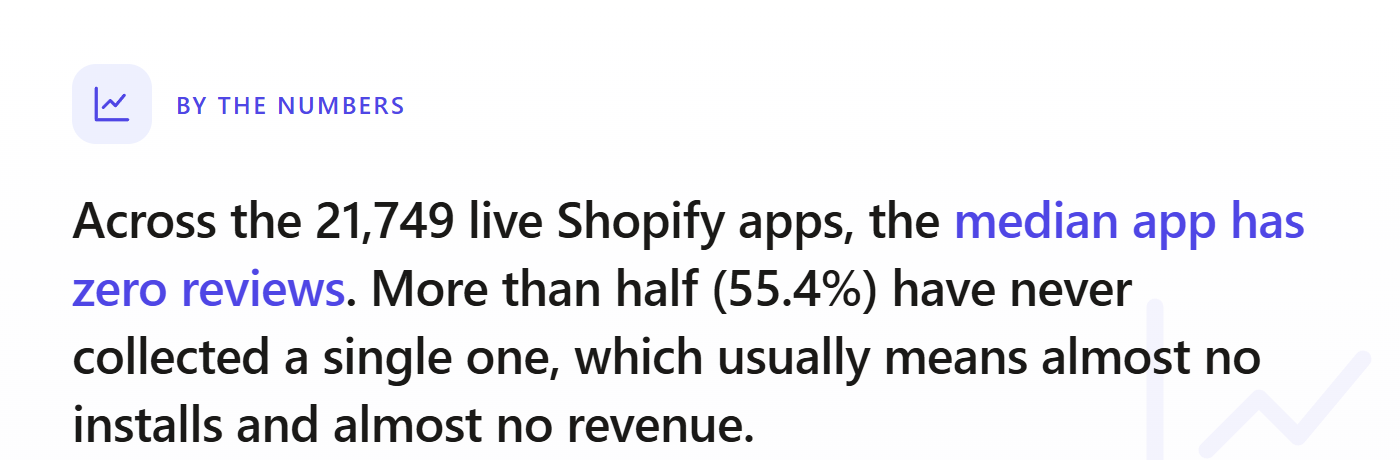
We scraped the live Shopify App Store: 21,749 apps. More than half of them, 55.4%, have never collected a single review. Three quarters have fewer than five. Since Shopify hides install counts from the public, reviews are the closest public stand-in for traction, and the picture they paint is blunt. The bottom half of the store is not a set of small businesses. It is mostly abandoned side projects, dead launches, and apps a few merchants installed and forgot.
So the useful question is not the average. It is: what does the part of the store that actually earns money look like, and how do you tell from the outside whether an app is in it?
The other half of the picture is where all those apps pile up. The biggest categories by app count are the ones everyone already guesses, and they are crowded for a reason: that is where the obvious revenue is, which is exactly why it is so hard to win there.
Biggest Shopify app categories by app count
Live Shopify App Store, MetricHQ scrape (June 2026). The crowded categories everyone already knows.
What "successful" actually pays
For the apps that do work, the numbers are real but grounded. A solid, well-run single Shopify app, one that owns a useful niche and keeps churn under control, typically sits in the $5,000 to $50,000 per month recurring range. That is a genuinely good outcome for one developer or a tiny team, and it is the band most sustainable app businesses live in.
Above that, a smaller tier of apps clears six figures a month, and a rare top slice runs as real companies doing seven or eight figures a year. Those are the exceptions, not the plan. If you are sizing a build, anchor on the $5k to $50k band as the realistic target for a strong first app, and treat anything past it as upside you earn, not a forecast you assume.
The math under those numbers is simple recurring revenue. At a $20 per month plan, you need around 250 paying merchants to reach $5,000 monthly, and around 2,500 to reach $50,000. That framing is more useful than any headline figure, because it turns "how much do apps make" into "how many merchants would actually pay me, and can I reach them." Most niches never get a builder anywhere near 2,500 paying customers, which is precisely why niche choice decides the outcome before the code does.
You keep almost all of it: Shopify's revenue share
One thing genuinely works in a builder's favor: Shopify's cut is small, especially early. Since January 1, 2025, developers keep 100% of the first $1,000,000 USD in gross app revenue earned each year, and 85% of revenue above that threshold. All billing carries a 2.9% processing fee, and there is a one-time $19 Partner registration fee to list at all. (Source: Shopify's revenue share documentation.)
That structure matters more than it looks. It means the platform is not the thing standing between you and a profitable app. Until you are past a million dollars a year, Shopify takes nothing but the payment-processing fee. So when an app fails to make money, it is almost never the revenue split. It is demand, competition, and distribution. The economics are set up so the only real question is whether merchants want what you built.
Reviews: the rough money proxy you can actually see
Because installs are private, reviews are the one public number that correlates with real traction. They are imperfect (some happy merchants never review, some apps farm reviews early), but at the scale of the whole store they are a reliable rough signal, and they are free to read.
Here is how to read them like a builder, not a browser:
- Volume tells you scale. An app with 2,000 reviews has serious install volume behind it and is almost certainly making real money. An app with 4 reviews is not, no matter how polished the listing looks.
- Pace tells you momentum. Twenty reviews in the last month means an app that is still winning installs today. Twenty reviews spread over four years means a listing that has stalled, even if the total looks respectable.
- Concentration tells you who owns the money. In most categories, the top two or three apps hold the overwhelming majority of all reviews, which means they hold most of the revenue too. The long tail under them is splitting scraps.
That last point is the one that quietly kills new apps. You can pick a category with thousands of monthly searches and still walk into a wall, because one or two incumbents (sometimes a first-party Shopify app) already hold the reviews, the rankings, and the revenue. Counting apps in a category is not enough. You have to read who holds the traction inside it. We go deeper on that in the most saturated Shopify app categories in 2026.
So is it worth building one?
Yes, but only with eyes open. The store is large and still growing, and a single app that lands in a real niche can comfortably support a developer or a small team. The honest version of the opportunity is this: the revenue ceiling per app is moderate, the platform cut is tiny, and the entire risk lives in picking a niche where merchants pay and the leaders are beatable.
My opinion, after reading the whole store: the builders who win do the boring market read first and fall in love with a problem second. The ones who lose write the code first and find out about the wall after three months. The difference is not talent. It is which order they did things in. If you want the longer version of that read, validate the idea before you write any code, and if you are still sizing the market overall, here is how many Shopify apps there actually are.
Reading a market before you commit
The four numbers that actually predict whether an app will make money are all public: how many apps already do the job, how concentrated the reviews are at the top, whether the existing apps charge (or give it away free), and whether Shopify itself already covers it. You can pull all four for any niche, and the read changes completely from one category to the next. That is the whole game, and it is why a guess is so much worse than a check.
The MetricHQ Market Validator does this read for you. You give it a niche, your target price, and a budget, and it scores the market on real App Store data: how fertile it is (what share of mature apps actually reach success), how the leaders are concentrated, whether the field monetizes, and a revenue-versus-ad-spend projection with a real break-even month. It turns "how much could my app make here" from a guess into a number you can look at before you build.
See what a niche can actually pay before you build
We scraped every app on the Shopify App Store. Check any niche for saturation, demand, and the gaps worth building, in seconds, before you write a line of code.