More than half of Shopify apps have zero reviews. Here is what that means for yours

More than half of the apps live on the Shopify App Store right now have zero reviews. We scraped all 21,749 of them, and 12,049 sit at exactly nought. That is not a sign the store is broken. It is the single most useful number a new app builder can know, because it tells you what "normal" actually looks like before you ever ship.
Zero reviews is the median, not the exception
Here is the distribution from our June 2026 scrape of every live app:
- 0 reviews: 55.4% (12,049 apps)
- under 5 reviews: 75.1% (16,326 apps)
- under 10 reviews: 81.8% (17,785 apps)
- 100 or more reviews: 5.4% (1,182 apps)
- 1,000 or more reviews: 0.7% (156 apps)
The median app, the one sitting dead in the middle of the whole store, has zero reviews. The app at the 90th percentile has only 34. So when your app launches and sits at 0 for weeks, you have not failed at anything. You have landed exactly where most of the catalogue lives. The store is a long tail with a very short, very loud head.
That reframes the goal. You are not trying to "get reviews" in the abstract. You are trying to climb out of a bucket that holds more than half the store, and the apps that do it share a pattern worth copying.
What a review actually represents (and why the count is a demand signal)
A Shopify app review is not free to produce. A merchant has to install the app, configure it, get enough value to bother, then go back to the listing and write something. Most never do, even when they keep the app installed and paying. That friction is exactly what makes the number honest.
So treat the review count as a rough public meter for how many merchants reached real value and cared enough to say so. It lags installs, it undercounts happy silent users, and it is gameable at the margins. But across thousands of listings the signal holds: more reviews, accumulating faster, means more merchants are getting somewhere with the app.
This is why the review count is the first thing I read on any competitor, before the pricing, before the feature list. The feature list tells you what they claim. The review count and its pace tell you what the market actually rewarded.
The 5.4% that hold 87% of the reviews
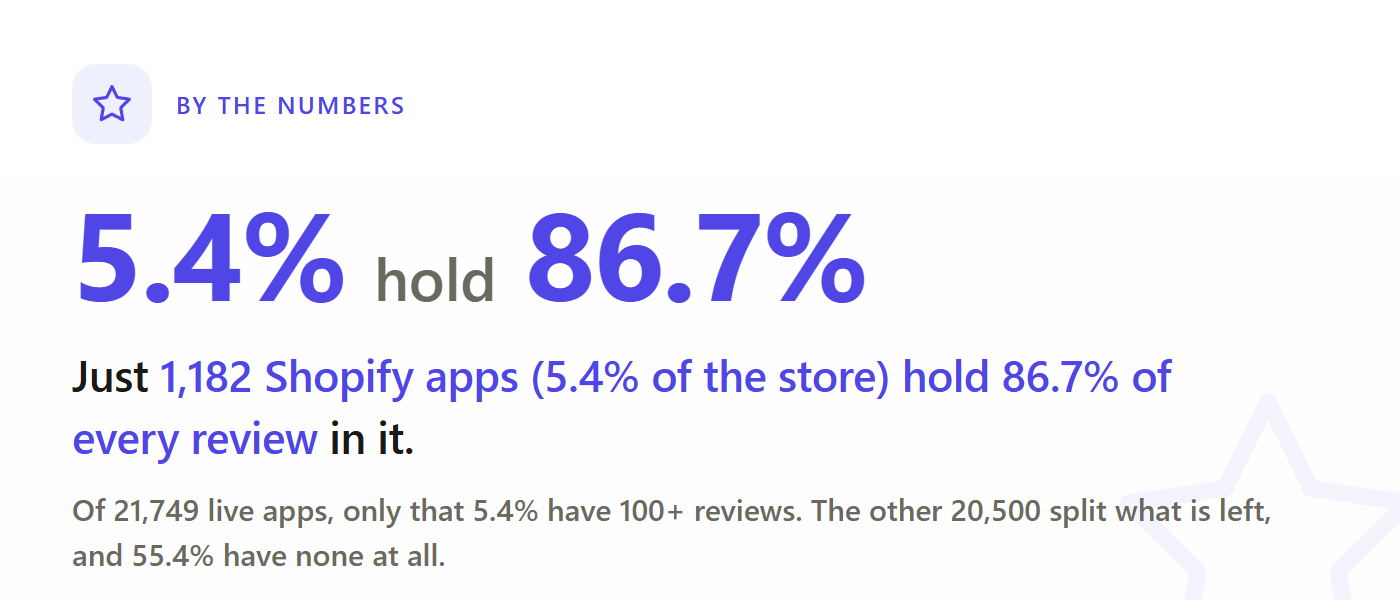
The concentration is the part most builders underrate. Of 831,704 total reviews across the store, 86.7% of them belong to the 1,182 apps with 100+ reviews. The other 20,500-odd apps split what is left.
A few things follow from that:
- The leaders are entrenched by social proof, not just product. An app with 4,000 reviews wins the click before a merchant reads a word, because nobody wants to be the first guinea pig. That moat is real and you cannot feature your way past it overnight.
- But "entrenched" is category-specific. A category whose top app has 3,000 reviews is a wall. A category whose "leader" has 60 reviews is barely defended, and a genuinely better app can take the top spot in a year. Same store, completely different odds, and the only way to know is to look per category.
- Review velocity beats review total for spotting opportunity. An app that gained 40 reviews in the last quarter is being actively adopted right now. One with 800 reviews that gained 3 is coasting. The first is the live market; the second is a legacy listing you might out-execute.
This is the read that decides whether a niche is worth your next year, and it is also the read that does not fit in a blog post, because it changes every month and it is different for every category. More on that below.
How to read reviews before you build
You do not need a tool to start. Open the App Store, pick the category you are considering, and sort the listing. Then read it like a demand report:
- Count the apps that actually compete. Ignore the dead listings with 0 reviews and no updates. How many apps have real traction (say 20+ reviews)? Five is a fight you can join. Forty is a knife fight.
- Look at the top app's review count. That number is the wall you would have to climb to be the obvious choice. Under ~100 is climbable. Several thousand is a multi-year grind or a niche you re-segment instead.
- Read the 1, 2, and 3-star reviews of the leaders. This is the highest-value 20 minutes you will spend. Merchants tell you, in their own words, exactly what the incumbent does badly: the missing feature, the broken edge case, the support they hate. That is your wedge, written for free by your future customers.
- Check the pace, not just the pile. A leader frozen at its review count for a year is vulnerable. A leader adding reviews every week owns the category for now.
- Mind the quiet categories. A whole category at near-zero reviews is ambiguous. It can mean untapped (merchants want this, nobody built it well) or dead (merchants do not want this, several people already found out). The 1-star reviews and the install counts tell you which. Do not read silence as opportunity by default. That is the most expensive mistake in this whole exercise.
If you want the longer version of step 0, deciding whether the idea is worth validating at all, we wrote that up separately in how to validate a Shopify app idea before you write any code. And if you are weighing which categories are already a knife fight, the most saturated Shopify app categories in 2026 maps the crowded lanes against the quiet ones.
What zero reviews means for YOUR app, specifically
Three honest takeaways for a builder staring at their own blank review count:
It is not a verdict. You are in the same bucket as the majority of the store on day one. The question is whether you can build review velocity, and that is a function of getting merchants to real value fast and then asking at the right moment, not of the launch itself.
Your first 5 to 10 reviews are the hardest and the most valuable. They move you out of the bottom 75% and give the next merchant the permission to try you. Earn them deliberately: onboard your first users by hand, fix what they hit, and ask once they have clearly succeeded.
Pick the fight before you pick the feature. A great app in a category walled off by a 4,000-review incumbent will still sit at zero for a long time. A good app in a category where the leader has 50 reviews can take the top slot. The category math decides more of your outcome than the code does, which is exactly why you read the reviews before you write any.
Turn the read into a number
Reading a category by hand works, and you should do it. But "is this niche beatable" deserves a real answer, not a vibe from scrolling. That means: how many apps actually compete, how high the review wall is, how fast the category is still being adopted, how many leaders are beatable on rating, and where the break-even lands if you put ad budget behind it.
That is exactly what the MetricHQ Market Validator computes from the same scraped dataset behind every number in this article. You type a market, your price, and a budget, and it returns the competition level, the review momentum, the share of incumbents you could beat on quality, and a revenue-versus-ad-spend projection with a real break-even month. It reads the demand signal for you, per niche, on current data.
It will not pick your idea for you. It will tell you, fast and on real numbers, whether the category you are eyeing is a wall or a wide-open lane, so you spend your next year on a fight you can win.
Is your category a wall or a wide-open lane?
We scraped every app on the Shopify App Store. Check any niche for saturation, demand, and the gaps worth building, in seconds, before you write a line of code.