Should you build a Shopify app in 2026? An honest look at the numbers

Should you build a Shopify app in 2026? Here is the honest answer: yes if you have a specific merchant problem and a way to get found, no if you are hoping a good app will sell itself. The store has nearly 22,000 live apps and most of them are invisible, so the deciding factor is almost never code quality. It is whether you picked a niche with real demand and thin competition, and whether you can reach the merchants in it.
The case for building one
The economics are better than most software businesses. You are building on top of a platform that already has the merchants, the billing, the auth, and the install flow. You do not have to acquire a base of paying businesses from scratch, you have to get noticed by the ones already shopping the App Store.
The revenue split is the friendliest part. Since January 1, 2025, developers keep 100% of their first $1,000,000 in gross app revenue per year, and 85% above that, with a 2.9% billing fee on charges (Shopify revenue share docs). Registering as a partner is a one-time $19. For a solo developer or a small team, that means almost everything you earn under seven figures is yours.
Build cost is low too if you keep the scope tight. A focused app that does one job well is a few weeks of work, not a funded company. We broke the real numbers down in how much it costs to build a Shopify app in 2026, but the short version: the build is rarely what kills an app.
So if the entry is cheap and the split is generous, why does most of the store look the way it does?
The brutal part: most apps are never found
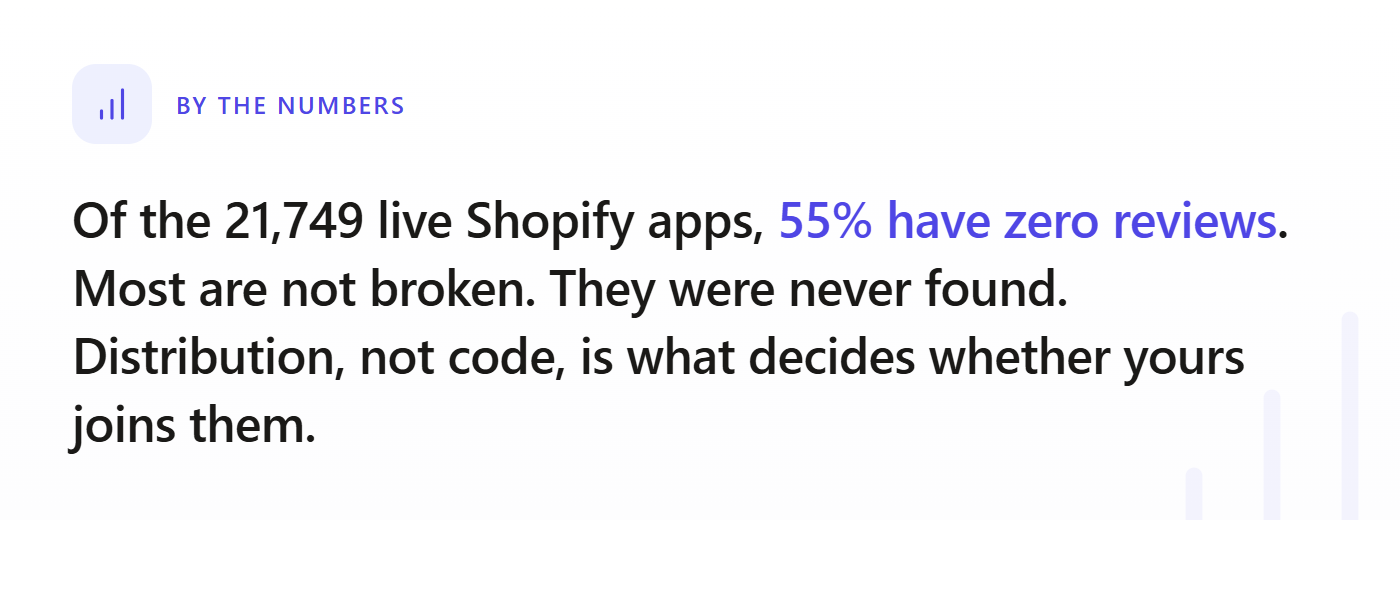
Here is the number that should set your expectations. Of the 21,749 live apps in the store, 12,049 have zero reviews. That is 55%. The median app in the entire Shopify App Store has exactly zero reviews.
Zero reviews almost never means the app is broken. Most of those apps install and work. It means no merchant ever found them, tried them, and cared enough to leave a rating. They shipped into silence. We dug into what that really signals in more than half of Shopify apps have zero reviews, and the takeaway is blunt: the App Store is not a meritocracy of code, it is a distribution game.
It gets narrower the higher you look. Only 1,182 apps, about 5.4% of the store, have 100 or more reviews. Just 330 apps have crossed 500. Only 1,495 apps, roughly 6.9%, carry the Built for Shopify badge. The top of the store is a small club, and the long tail underneath it is enormous and quiet.
The honest read: building the app is the easy 20%. Getting it found is the 80% that decides whether you join the 5% or the 55%.
How many Shopify apps reach each review tier
All 21,749 live apps in the Shopify App Store, by review count (Jun 2026 scrape).
Who should build a Shopify app
Build if you fit one of these. These are the people who tend to make it work.
- You have a specific, named merchant problem. Not "an analytics app," but "stores running pre-orders cannot cap how many units a customer reserves." Specific problems have specific buyers who search for the exact thing. Vague apps compete with everyone.
- You already have a way to reach merchants. An audience, a niche agency, a Slack or Discord full of store owners, an existing app you can cross-sell from. Distribution you already own is worth more than the feature itself.
- You picked the niche before the feature. The smart move is to find an underserved category first, confirm the demand and the thin competition, and only then decide what to build. The reverse order, building the thing you think is cool and then looking for a market, is how you land in the zero-review pile.
- You are willing to do the unglamorous part. App Store Optimization, getting your first reviews, answering support, earning the Built for Shopify badge (Shopify reports roughly +14% installs for apps that earn it). The work after launch is the work.
Who should not
Be honest with yourself if any of these is you.
- Your plan is "build a great app and it will get discovered." It will not. The 12,049 zero-review apps are full of perfectly good software. Quality is the price of entry, not the differentiator.
- You picked a saturated category because it is obviously big. Analytics has over 1,200 apps. Upsell and cross-sell has more than 900. Going head to head with hundreds of incumbents, some with thousands of reviews and the badge, is the hardest possible start. The crowded categories are crowded because they were the obvious ideas. We mapped which ones are walls in the most saturated Shopify app categories in 2026.
- You need it to pay off this quarter. Most apps grow slowly. Paid acquisition in competitive categories can take a year or more to break even at a realistic budget and price. If you cannot fund a long ramp, pick a niche where you can grow on organic App Store search instead.
- You have not validated demand yet. Building first and validating later is the expensive order. Do it the other way. Here is how to validate a Shopify app idea before you write any code.
How to actually decide
The decision is not "is the App Store too crowded" in general. It is too crowded in some categories and wide open in others, and the only question that matters is which one your idea lands in. That comes down to four readable signals:
- App count in the category. How many apps already solve this? A handful is opportunity. Hundreds is a wall.
- Review concentration. Are reviews spread across many decent apps, or hoarded by two or three giants? A category owned by a couple of incumbents is brutal to break into.
- First-party walls. Is Shopify itself, or a default theme feature, already doing most of this for free? If so, your ceiling is low no matter how good your app is.
- Real, current demand. Are merchants actively searching for this, or is it a problem you imagine they have?
You can read all four by hand if you are patient: count the apps, scan the review distributions, check what Shopify ships natively. That is exactly the work the MetricHQ Market Validator does for you, across the full live store, so you get the read on your specific niche in seconds instead of an afternoon of manual counting.
The example above is one real market. The point is the shape of the answer: a quality score, how beatable the leaders are, what it realistically costs to compete, and when ads pay back. That is the difference between a guess and a decision.
Check your niche before you build
We scraped every app on the Shopify App Store. Check any niche for saturation, demand, and the gaps worth building, in seconds, before you write a line of code.
The honest verdict
Should you build a Shopify app in 2026? If you have a specific problem, a way to reach the merchants who have it, and the patience to do the distribution work, yes, and the economics will reward you. If you are betting that a good app sells itself, no, because 55% of the store already tried that and the store never noticed.
The store is not too full. It is too full of apps that skipped the part where you check whether anyone wanted the thing first. Do that part, pick a niche that is actually open, and you are building in a market that still has room.