Shopify App Store statistics 2026: the numbers builders actually need

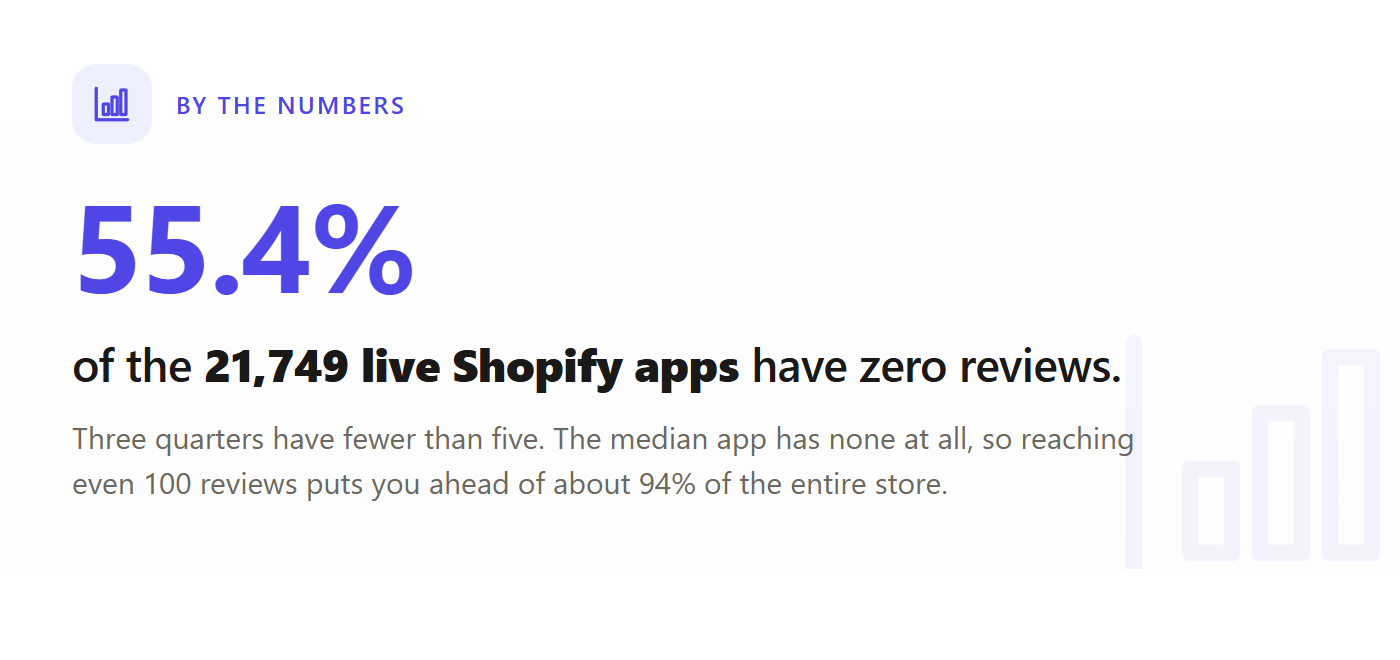
Here are the Shopify App Store numbers a builder actually needs in 2026, pulled from a full scrape of the live store, not a sample. There are 21,749 live apps. More than half of them (55.4%) have zero reviews. About 44% offer a free plan. And the single most useful fact for anyone deciding what to build: getting noticed is far rarer than shipping. This page is the cheat-sheet I wish I had open in another tab while planning an app, with every store-wide figure straight from the data and every policy figure linked to its Shopify source.
The one number to quote: 21,749 live apps
When you see "the Shopify App Store has over 13,000 apps" or "more than 8,000 apps," those figures are stale or count something different. We scraped every currently-live listing and counted 21,749. That is the population, not an estimate, and it is the only total I would put in a pitch deck or a competitive analysis.
The gap matters because the wrong number changes your read of the market. Plan against 8,000 apps and you will badly underestimate how crowded your category already is. The store is roughly twice as full as the commonly-cited figures suggest, and it keeps adding listings. (For how fast it is growing and whether building is still worth it, see our full scrape of the market. This page is the static snapshot; that one is the trend.)
The review distribution: this is where builders should look
Almost every "App Store stats" post stops at the app count. For a builder, the review distribution is the number that actually predicts your odds, because in the App Store reviews are the currency. They drive ranking, they drive install confidence, and they are the hardest thing to fake or buy.
Here is the full picture from the scrape:
- 55.4% of apps (12,049 of them) have zero reviews.
- 75.1% have fewer than five reviews.
- The median app has 0 reviews. Not "a few." Zero.
- Only 5.4% of apps have reached 100 reviews, and just 0.7% have crossed 1,000.
How many reviews live Shopify apps actually have
All 21,749 live apps, by review count. Full scrape, June 2026.
Read that again, because it reframes the whole challenge. The hard part of a Shopify app is not building it or even launching it. More than half the store has shipped and then gone silent. The real bottleneck is the first 100 reviews, a threshold only one app in twenty ever clears. That is the wall.
There is a hopeful side to the same number. The store is top-light. If 0.7% of apps have real review moats, then in most categories the leaderboard is shorter than it looks, and the apps sitting at 8 or 20 reviews are not defensible positions. A focused new app with a real wedge can pass most of the field faster than you would expect. The 100-review club is small enough that joining it puts you ahead of 94% of the store.
(Worth noting on method: this is a snapshot of currently-live apps, so it reads current-state competition accurately. It is not a "reviews over time" series, and I would not use it to claim a growth rate. Snapshot questions only.)
Free vs paid: 43.8% offer a free plan
43.8% of apps (9,517) offer a free plan or a free option. That is close to half, and it sets the pricing expectation merchants walk in with. A merchant browsing your category has a roughly even chance of seeing a free competitor next to you.
That does not mean you must be free. It means a paywall with no free entry point is a choice you should make on purpose, with a reason a merchant will accept (clear value, a trial, a low first tier). Among apps that have actually earned reviews, monetization is healthy: in our validator's read of a typical market, the large majority of established apps do charge. Free is the front door, not the business model.
The practical takeaway: decide your free-tier strategy before you build, not after. Retrofitting a free plan onto an app architected for paid-only is painful, and going paid-only in a category where 40%-plus of rivals are free needs a sharper pitch than most first apps have.
The badge: only 6.9% are Built for Shopify
Just 6.9% of live apps (1,495) carry the Built for Shopify badge. It is rarer than most builders assume, which is exactly why it is worth chasing. Shopify reports the badge is associated with roughly a 14% lift in installs (Shopify's Built for Shopify guidance), and in a store where 93% of apps do not have it, it is a real differentiator on a listing.
It is not a vanity sticker. Earning it forces performance, embedding, and review-handling standards that make a better app anyway. Treat it as a roadmap milestone, not an afterthought.
The economics: what Shopify actually takes
This is the part builders get wrong most often, usually by assuming Shopify takes a big cut from dollar one. It does not. The current terms, straight from Shopify:
- You keep 100% of your first $1,000,000 USD in gross app revenue per year (effective for earnings from January 1, 2025).
- Above that, you keep 85% (Shopify takes 15%).
- A 2.9% processing fee applies to billing through Shopify.
- Becoming a Shopify Partner is a one-time $19 USD registration.
Source: Shopify's revenue share documentation. The headline here is genuinely good for small builders: your first million a year is effectively yours minus payment processing. The platform only starts taking a meaningful share once you are already successful, which is the right place for it to start.
Build cost: the honest range
People ask "what does a Shopify app cost to build" expecting one number. There isn't one. An agency MVP for a public App Store app commonly runs $30,000 to $150,000 depending on scope, with hourly rates from roughly $100 to $400 (2026 cost breakdowns from app-dev agencies). Treat those figures as what an agency charges, not what the work inherently costs.
The honest version for a solo or small builder: if you write it yourself, the cash cost is close to the $19 Partner fee plus hosting. The real cost is your time, and the real risk is not the build, it is building something nobody installs. Which is the whole point of the next section.
The numbers that should change your plan
Put the snapshot together and a clear builder lesson falls out:
- Shipping is common. Being noticed is rare. 55.4% at zero reviews proves it.
- Reaching 100 reviews puts you ahead of roughly 94% of the store. That is the goal to design backwards from.
- Nearly half the store is free at entry, so plan your pricing on purpose.
- The badge (6.9%) and the top of the review distribution (0.7% over 1,000) are where defensibility lives, and both are reachable in an underserved category.
The single most expensive mistake is picking a category that is already walled off, then discovering it after you have built. Raw app count alone will not tell you that, because a category can be small in count but locked by a first-party Shopify app or one dominant incumbent. (We dug into exactly that in the most saturated Shopify app categories in 2026.) The numbers on this page are the store-wide baseline; the read you actually need is per-niche.
Validate the niche before you write code
These store-wide stats tell you the shape of the whole store. They do not tell you whether your category is open, how beatable its leaders are, or what a realistic path to those first 100 reviews looks like. That read is per-niche, it changes month to month, and it is exactly what guessing gets wrong.
That is what we built the MetricHQ Market Validator for. You type in a market, your price, and an ad budget, and it reads the live App Store data for that niche: how many apps, how concentrated the reviews are, whether a first-party app holds the category, how many established apps actually clear a review bar, and a real revenue-versus-ad-spend projection with a break-even month. It is the per-niche version of every number on this page.
Before you commit months to an app, it is worth knowing whether the category will let you in. (For a full pre-build checklist, see how to validate a Shopify app idea before you write any code.)
Get the read on your niche, not just the store
We scraped every app on the Shopify App Store. Check any niche for saturation, demand, and the gaps worth building, in seconds, before you write a line of code.