How app reviews drive Shopify ranking: the flywheel for new apps

How app reviews drive Shopify ranking: the flywheel for new apps
Reviews are the single biggest lever a new Shopify app has over its search ranking. More reviews lift you in App Store search, search position drives installs, and installs are what produce the next batch of reviews. That loop is the whole game, and most new apps never start it: in our scrape of the live App Store, 55.4% of apps have zero reviews. This is how the flywheel works, why it stalls, and how to get the first turns out of a brand-new listing.
The flywheel, in one loop
Picture four stages that feed each other:
- Reviews raise your App Store search ranking and your star rating.
- Ranking puts you higher on category and keyword results, where most installs come from.
- Installs put your app in front of more merchants.
- Active merchants are the people who leave the next reviews, which raises ranking again.
Each turn makes the next turn easier. An app sitting at position 3 for "product reviews" gets a flood of impressions it never has to pay for, and a slice of those installs convert into new reviews that defend the position. That is why the leaders look unbeatable: they are not just ahead, they are compounding.
The flip side is the part nobody warns you about. The same loop runs in reverse at zero. No reviews means a low rank, a low rank means almost no organic installs, and no installs means no one to ask for the first review. A new listing does not gently ramp. It sits at a dead stop until something external pushes it.
Why reviews matter so much to Shopify ranking
Shopify does not publish its exact ranking formula, and you should be suspicious of anyone who claims to. But Shopify states the link itself plainly. Its own developer guide on managing app reviews says that "positive reviews make your app appear higher in Shopify App Store search results and category pages." That is about as direct as it gets: reviews move you up the results merchants actually browse.
Reviews do two things at once. They are a ranking input, and they are the social proof that decides whether an impression becomes an install. A merchant scanning a category page reads the star rating and the review number before they read a single word of your pitch. Forty reviews at 4.9 stars beats a blank listing every time, even if the blank listing is the better app.
So reviews are not a vanity metric. They are upstream of almost everything else a new app cares about.
The cold start is the real problem
Here is the uncomfortable shape of the market. We scraped all 21,749 live apps on the Shopify App Store in June 2026, and the review distribution is brutally top-heavy:
- 55.4% of live apps (12,049 of them) have zero reviews. The median app has zero.
- 75.1% have fewer than five reviews.
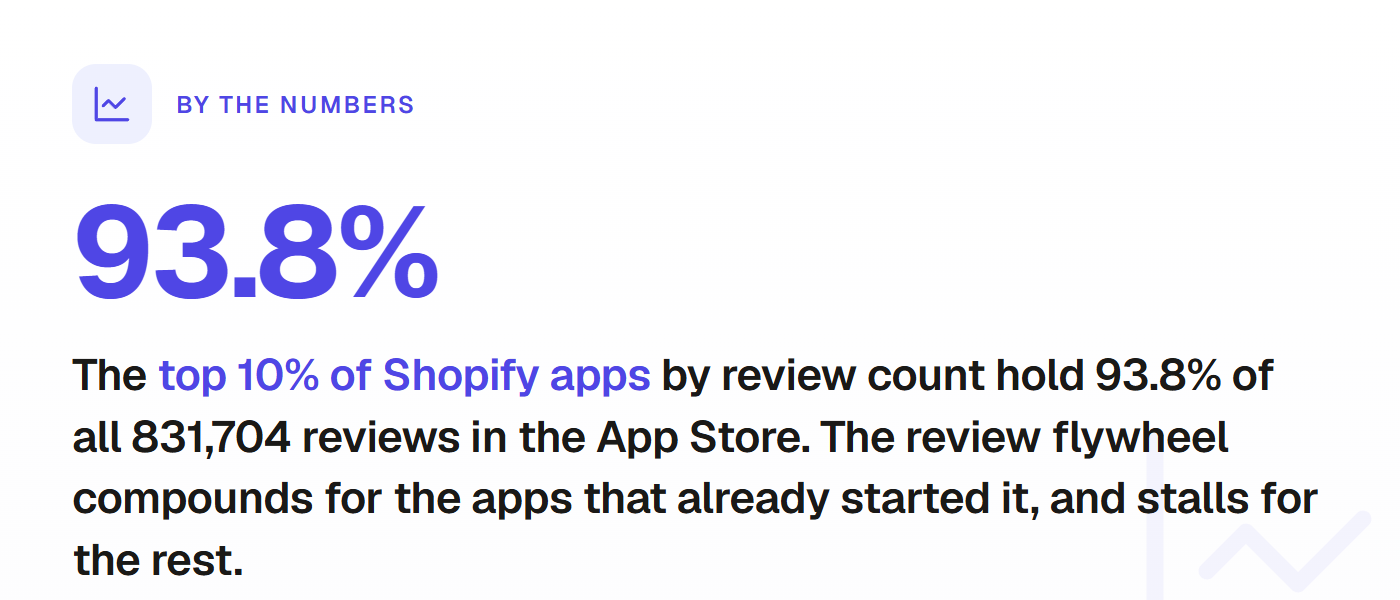
- The top 10% of apps by review count hold 93.8% of all 831,704 reviews in the store.
- Just 159 apps account for half of every review ever left.
Live Shopify apps by review count (June 2026 scrape)
Our scrape of all 21,749 live apps. Most of the store never clears the first few reviews.
That is not a gentle curve, it is a cliff. The flywheel is real, but it only spins for the apps that already got it moving. More than half of all apps are parked at the bottom of the hill with the brake on, which tells you the cold start is where almost everyone fails, not the climb after it.
My read on this: the number that matters for a new app is not "how many reviews does the leader have," it is "how few reviews do I need to clear the floor." Getting from zero to your first ten reviews is a different and harder job than getting from ten to a hundred. The first ten have no flywheel helping them. You are pushing the wheel cold.
How a new app gets the first turns
You cannot rank your way to your first reviews, because you have no rank yet. So the first turns come from outside the loop. Three things move the wheel from a standing start.
1. Seed installs from a small, motivated base
Organic search will not find you on day one. Bring your own first installs: a beta list, a handful of merchants in a niche community, partners you already work with, your own test stores' real owners. You do not need hundreds. You need enough genuinely-active installs that asking for reviews produces a few real ones. Twenty engaged merchants who actually use the app beat two hundred who installed and forgot.
2. Ask for the review at the moment of value
The single biggest mistake is asking too early or never asking at all. A merchant will not review an app they installed yesterday and have not seen do anything yet. Shopify's own guide to managing app reviews says to ask after a positive interaction, like a good support exchange, using in-product messaging that does not block their workflow, and to let them opt out. Tie that to a moment of value: right after the app delivers something the merchant can see, the first recovered cart, the first synced order, the first bundle that converts. A short in-app prompt at that point converts far better than an email a week later.
Two hard limits, both straight from Shopify's guidance. Do not ask only your happy users for reviews (you must invite feedback neutrally, not solicit positive ones), and do not ask during onboarding or installation, before the app has done anything. Make it easy, keep it neutral, and never gate features behind a review.
3. Earn the quality signals you are allowed to earn
Built for Shopify is the clean version of a ranking boost. The badge earns better placement and visibility (see Shopify's Built for Shopify program details), and Shopify has reported roughly +14% installs for apps that earn it. In our scrape only 6.9% of apps (1,495 of 21,749) carry the badge, so it is both a real lift and a way to stand out from the 93% that do not. It rewards exactly the things that also earn good reviews: fast load, clean install, no broken states. You are not gaming the loop, you are making the app good enough that the loop runs.
What kills the flywheel: faking it
The fast path is the one that ends the project. Buying reviews, swapping them with other developers, incentivizing merchants with discounts or gift cards, leaving reviews on your own app, or spinning up fake accounts all break Shopify's review policies and the Partner Program Agreement. Shopify removes reviews it finds to be fake, incentivized, or left by a developer on their own or a competitor's app, and the listed consequences go further than that: a demoted ranking, removal from promotional surfaces, or the app being unpublished from the App Store.
Beyond the policy risk, fake reviews break the loop they were meant to start. The flywheel works because real installs leave real reviews that bring real installs. Salt it with fakes and your install-to-review ratio stops meaning anything, your rating misleads the merchants you do reach, and the first one-star "this does not do what the reviews say" undoes ten purchased five-stars. The only durable way to spin the wheel is to be worth reviewing.
Before you build: is the flywheel even winnable in your niche?
The flywheel is the same everywhere, but the cold start is not equally hard in every category. In a niche where the leaders sit on thousands of reviews and a four-year head start, your first ten reviews barely register against the floor. In a thin or new category, a handful of reviews can put you on page one. The smart move is to pick the fight before you build, not after.
That is a market-shape question, and it is exactly what we built the MetricHQ Market Validator to answer. Point it at a niche and it reads the live App Store data for that category: how many apps already compete, how concentrated the reviews are at the top, how beatable the leaders actually look, and whether real demand is there. It is the same scraped dataset behind every number in this article, turned into a per-niche read so you can see whether the flywheel is winnable for you before you write a line of code.
If you have not framed your idea yet, start with how to validate a Shopify app idea before you write any code, then check where your niche sits in the most saturated Shopify app categories in 2026.
See if the review flywheel is winnable in your niche
We scraped every app on the Shopify App Store. Check any niche for saturation, demand, and the gaps worth building, in seconds, before you write a line of code.
The takeaway is simple. Reviews drive ranking, ranking drives installs, installs drive reviews, and a new app's only job is to push the first few turns by hand before that loop carries it. Most apps never push at all, which is precisely why the apps that do pull so far ahead.