Freemium, free trial, or paid: which pricing model Shopify apps actually use

Freemium, free trial, or paid: which pricing model Shopify apps actually use
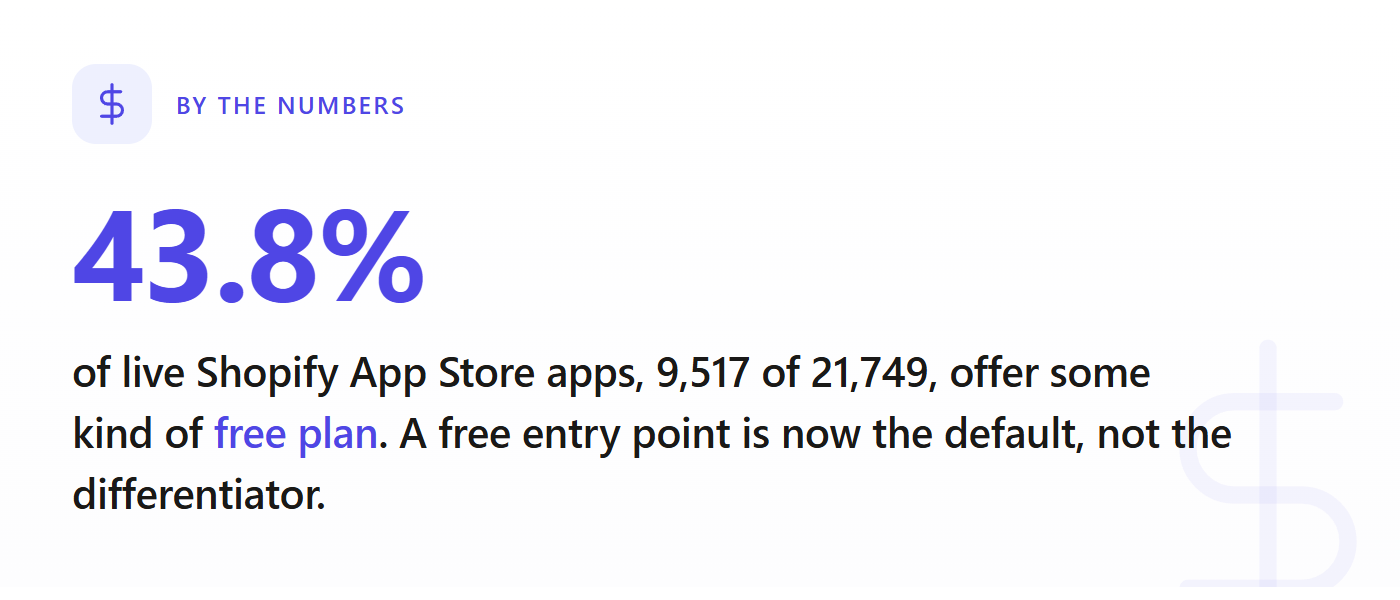
There are three ways to charge for a Shopify app: a free plan you upsell from (freemium), a paid plan with a trial, or paid from day one. In our scrape of the live App Store, 43.8% of apps offer some kind of free plan and about half offer a free trial on at least one paid plan, so "let people in for free first" is now the default posture, not the bold one. But default does not mean correct. The right model depends on how a merchant feels the value, how fast they feel it, and how cheap each free user is for you to carry. This is the part most builders pick on vibes, and it quietly decides your conversion rate for the life of the app.
The three models, defined for Shopify specifically
Shopify's billing API lets you charge a recurring fee, a usage fee, a one-time fee, or nothing, and it gives you a native trial window on recurring charges. Everything below is built from those primitives.
Freemium is a permanent free plan plus one or more paid tiers. The free plan is not a trial that expires, it is a real product with a usage ceiling (a number of products, orders, popups, whatever your unit is). The merchant lives on free indefinitely and upgrades when they hit the wall. About a third of apps in our data run this shape: a free plan sitting under at least one paid plan.
Free trial means the merchant picks a paid plan but is not billed until the trial ends. There is no permanent free tier. They get the full app for 7 or 14 days, then the charge starts unless they uninstall. This is the most common single posture in the store: just under half of apps put a trial on at least one plan.
Paid-only means the charge starts at install, no free plan and no trial. It is the minority, and there is nothing wrong with that. Roughly 7% of apps charge from day one with no trial at all. It tends to be deliberate: the app costs real money to run per merchant, or it serves buyers who already know they need it.
Most real apps are a blend. A free plan with a paid tier that itself has a trial is common, and counts as both freemium and trial. The question is never "which one label," it is "what is the merchant's first paid moment and how do they get there."
How to actually choose: three questions
Forget what is fashionable. The model falls out of three honest answers about your app.
1. How fast does the merchant feel the value?
If a merchant installs your app and sees the point in five minutes, a trial is almost wasted on them, and a free plan lets them confirm the value risk-free before they ever pay. If your value compounds over weeks (a loyalty program filling up, an SEO change getting indexed, a returns flow accumulating saved revenue), a free plan can trap them at zero usage forever, and a trial with a hard clock pushes them to actually set it up. Match the clock to the time-to-value. A short trial on a slow-value app is the most common pricing mistake we see, because the merchant never reaches the "oh, this works" moment before the bill lands.
2. How cheap is a free user to carry?
Every free user costs you something: support tickets, server calls, API rate limit headroom, a slot in your own attention. If a free user costs near zero to serve, freemium is close to free marketing, the unconverted users are a funnel and a review source, not a liability. If each user runs expensive jobs (image generation, AI calls, heavy syncs), a permanent free plan is you paying for people who may never convert. That app wants a trial or paid-only, so the meter only runs on people who have committed.
3. Is the buyer high-intent or browsing?
A merchant searching "abandoned cart recovery" already knows they have the problem and want a fix. High intent tolerates a paywall or a trial, they are shopping to buy. A merchant who stumbles onto a "nice to have" needs a free plan to even try it, because they have not decided they need it yet. The more obviously your app is a must-have for a specific job, the more you can charge up front. The more it is a maybe, the more a free entry point earns its keep.
If you have not yet read the demand and crowding for your specific niche, do that first. We walk through it in how to validate a Shopify app idea before you write any code, because the pricing model only matters once you know merchants actually want the thing.
What the trial-length data actually says
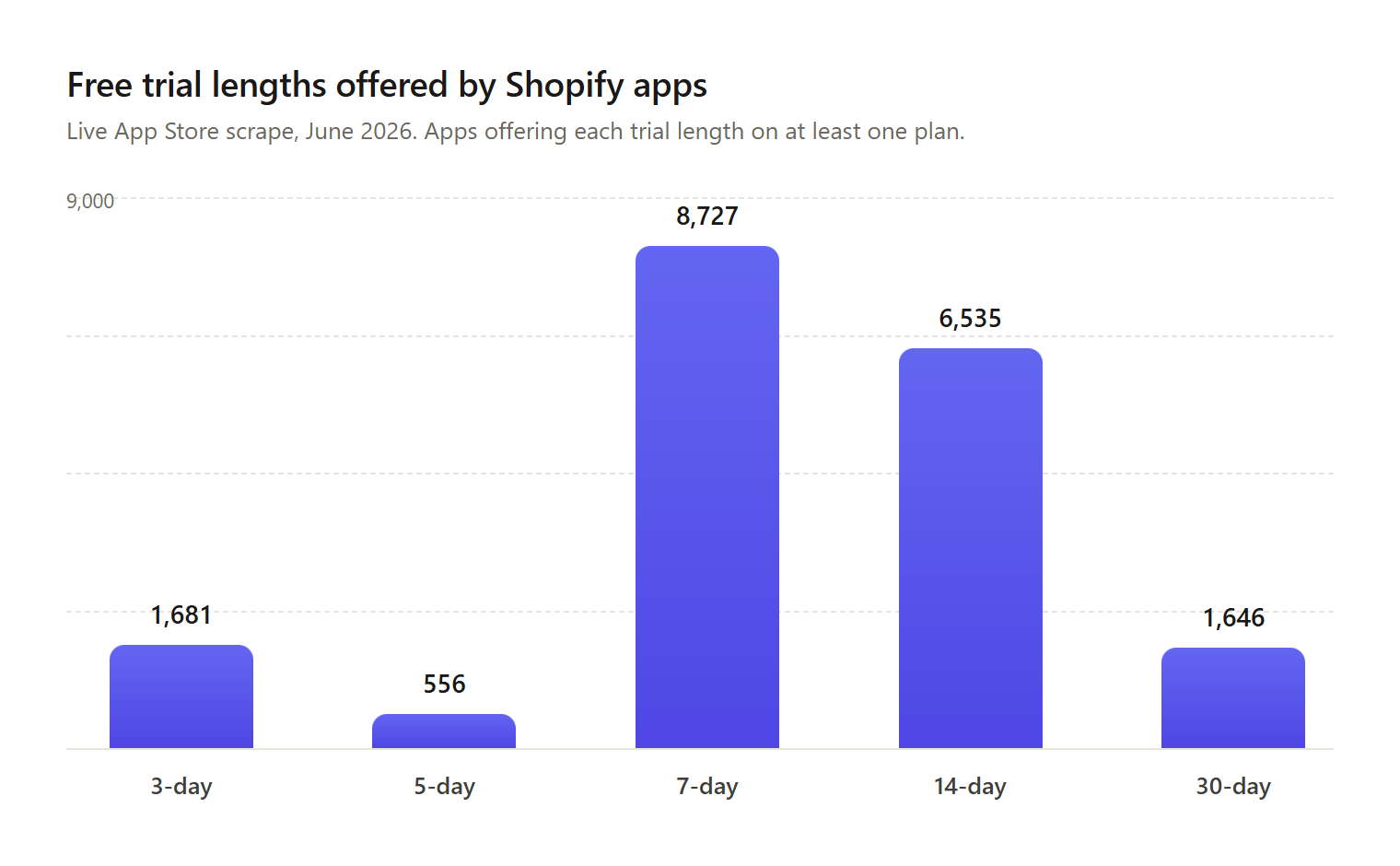
When builders do run a trial, two lengths dominate and the rest is noise. The 7-day trial is the single most common, and the 14-day is a close second. Together they are the overwhelming majority of every trial offered in the store. The median trial length across apps that offer one is 7 days.
The lengths in between, the 3-day and 5-day trials, are more common than you would hope and usually a mistake. Three days is barely a weekend. A merchant installs on a Friday, gets pulled into running their actual store, and the trial is gone before they configured anything. Unless your value lands in the first session, a sub-week trial mostly converts the people who would have paid anyway and burns everyone else.
My read: default to 7 days if value is fast, 14 if setup takes real work, and only go shorter if you have a specific reason. Longer than 14 rarely helps; it just delays the revenue and gives indecisive merchants more time to forget you exist.
The freemium trap, and the Shopify-specific version of it
Freemium's failure mode is a free plan so generous that nobody needs to upgrade. On Shopify this has a specific shape: the free tier solves the whole job for a small store, and small stores are most of the App Store's addressable base. You end up with a huge free user count, a wall of reviews, and a tiny revenue line, because the merchants big enough to pay are a thin slice at the top.
The fix is to draw the free ceiling at the line where the merchant starts making real money from your app, not below it. Free should prove the value and then stop right as it gets good. If your free plan caps at "10 of X," ask whether a store hitting 11 is a store that is now earning from your app. If yes, that is a healthy wall. If they can run a real business forever on the free tier, you built a free app with a donation button.
When paid-only is the right call
Charging from install feels aggressive, and for the right app it is simply honest. Paid-only fits when the merchant already knows they need the category (high intent), when each user is genuinely expensive to serve, or when a free tier would attract a flood of low-quality stores that bury you in support and never pay. It also filters for serious merchants, which can mean better reviews and lower churn than a freemium funnel clogged with abandoned free installs.
The risk is real too: no free plan and no trial means every install is a leap of faith, so your listing, screenshots, and reviews have to do all the convincing a trial would otherwise do. If your App Store presence is thin, paid-only will feel like a wall. Earn the trust first, then you can charge for it.
There is one more lever worth knowing: Shopify lets you keep 100% of your first $1,000,000 in gross app revenue per year, and 85% above that (Shopify revenue share). That economics rewards getting merchants to a paid plan, not parking them on free forever. Free is a means to a paid customer, not the goal.
See the pricing mix in your actual niche
Store-wide averages are a starting point, not an answer. The right model depends on your specific category, and the pricing mix swings hard between niches: some are a race to the cheapest free plan, others are paid-only markets where merchants expect to pay and a free tier would just signal a hobby project. A category where every leader charges from day one is telling you something. So is one where the top apps are all free with a paywall buried deep.
We built the MetricHQ Market Validator to read this for your niche specifically: it pulls the live App Store data and shows how crowded the category is, how beatable the leaders are, what share of apps actually charge and at what price, and a projection of what it takes to break even at a given ad budget. It runs on the same full scrape behind every number in this article. If you are deciding what to charge, seeing how the apps you are about to compete with charge is the read that matters, far more than any store-wide percentage. It pairs well with knowing which categories are already saturated and how fast the whole store is growing.
See how apps in your niche actually price before you pick a model
We scraped every app on the Shopify App Store. Check any niche for saturation, demand, and the gaps worth building, in seconds, before you write a line of code.
Pick the model your economics point to, not the one everyone else copied. Free is the default in the store, but the default is not always your best move, and the builders who think it through instead of defaulting to it are the ones who get paid.
Free trial lengths offered by Shopify apps
Live App Store scrape, June 2026. Counts apps offering each trial length on at least one plan.