How to break into a Shopify app category run by incumbents

How to break into a Shopify app category run by incumbents
You break into a category run by incumbents the same way every challenger app ever did: you do not fight the leader on the thing it is strongest at. The leader's moat is almost never its code. It is the review pile, the brand, and the integrations it had years to build. So you pick a narrow beachhead the incumbent treats as an afterthought, win that slice completely, and grow outward from a base that is genuinely yours. This article is the method for finding that opening, with real numbers from our scrape of the full Shopify App Store.
First, be honest about what the moat actually is
Before you write a line of code, get clear on why the leader is the leader. Founders new to the App Store assume the top app won on features. It almost never did. It won early, accumulated reviews, and now those reviews do the selling.
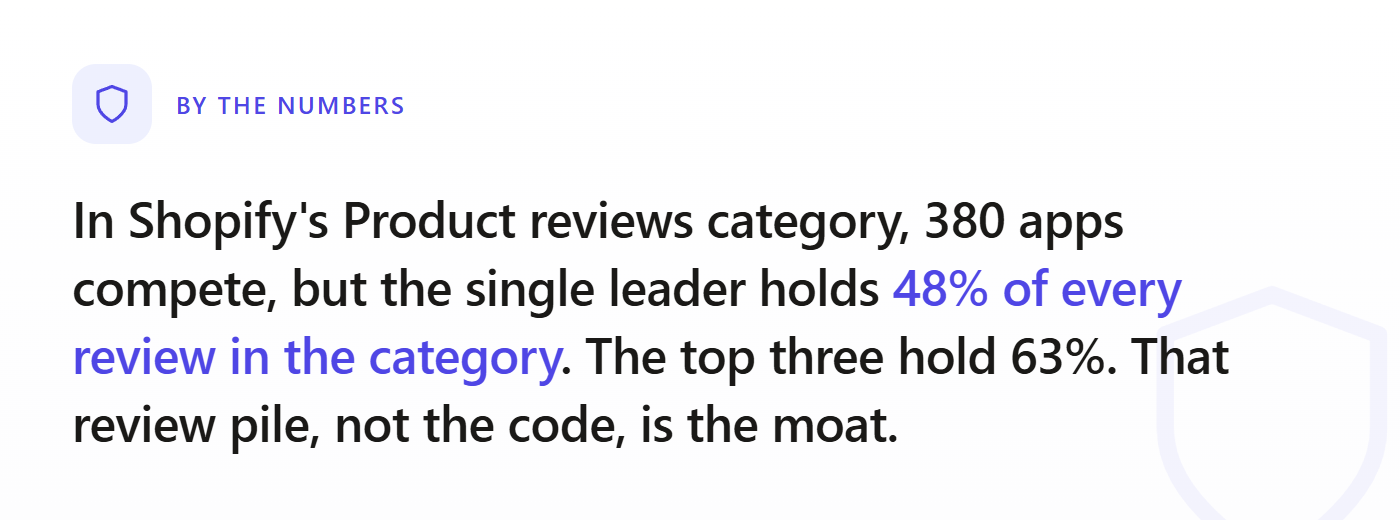
Take the Product reviews category. There are 380 live apps in it. The leader, Judge.me, holds about 40,000 reviews, which is 48% of every review in the whole category. The top three apps together hold 63%. The median app in that category has exactly one review, and 72% of the apps have fewer than ten. Only 13 of the 380 have crossed a thousand reviews.
Read that distribution again, because it is the whole game. A merchant browsing the category sees the leader at the top with a wall of social proof and everything else looking abandoned. The features below the fold might be better. Nobody scrolls far enough to find out. That review gap, not a feature gap, is what keeps the incumbent on top, and it is exactly what you cannot copy by shipping faster.
This is also why "I will just build a better version" is the most common way new app founders waste a year. A better version of an app nobody can find is still invisible.
Where incumbents are actually weak
A market leader that serves everyone is, by definition, optimized for the average merchant. That averaging is the opening. Three weaknesses show up again and again.
1. The interface got old while the company got big
The app that won the category in 2018 is usually still carrying its 2018 information architecture. Big incumbents move slowly because every change risks their existing base and their enterprise contracts. A modern, fast, genuinely pleasant setup flow is a real wedge, especially for the small and mid-size merchants who do their own setup and feel every click. If the leader's onboarding takes thirty minutes and a support ticket, yours taking three minutes is a feature merchants will mention in reviews.
2. The pricing model people quietly resent
Look at how the leaders charge. A lot of category kings monetize in ways their users tolerate rather than love: per-order fees that scale painfully as the store grows, mandatory annual contracts, or a free tier so stripped it is really a demo. Resented pricing is a durable opening because the incumbent usually cannot fix it without hurting its revenue. If the leader charges a percentage of every order and you charge a flat fee, you have a story that writes itself for any store doing volume.
3. The niche it cannot afford to specialize for
This is the big one. The leader has to be generic because it serves 50,000 stores across every vertical. That means it is mediocre at the specific. A reviews app built for everyone cannot also be the perfect reviews app for furniture stores that need photo reviews with assembly notes, or for supplement brands that need to handle health claims carefully, or for a single non-English market the incumbent half-translated. The incumbent will not chase your niche because the niche is too small to move its numbers. For you, that niche is the entire business.
Pick a beachhead, not a battlefield
The beachhead idea comes from how challengers actually win crowded markets: take a slice small enough that you can dominate it, win it completely, then expand from a position of strength. On the App Store the slice usually comes from one of these:
- A merchant type. Not "stores," but "Shopify Plus furniture brands" or "single-product DTC supplement stores." Build the workflow that exact merchant needs and the generic leader cannot justify building.
- A geography or language. A category leader that is English-first and mediocre in German, Japanese, or Brazilian Portuguese is wide open in those markets. Local language, local payment quirks, local support hours.
- A workflow the leader buried. The incumbent does twenty things acceptably. Find the one thing it does badly that some merchants care about intensely, and be the app that does only that, brilliantly.
- An integration the leader skipped. Deep, first-class support for a specific theme, page builder, or adjacent app the incumbent treats as a checkbox.
The test for a good beachhead is simple. Can you describe the exact merchant who would switch to you in one sentence, and is that sentence specific enough that the incumbent would never write it on their homepage? If yes, you have a wedge. If your answer is "anyone who wants reviews," you are about to walk into 380 apps and a 48% incumbent.
We wrote a companion piece on the step before this one, validating a Shopify app idea before you write any code; the beachhead test belongs in that validation, not after you have built.
The review moat works both ways
Here is the part founders miss. The same review concentration that protects the incumbent is the thing you are building for yourself, one delighted merchant at a time. A narrow beachhead is how you get those first reviews fast, because a specific audience that you serve perfectly leaves reviews. A generic audience that finds you mildly useful does not.
So the plan is not "beat the leader's review count." That takes years and you will lose. The plan is "own a slice so completely that you are the obvious choice inside it," collect the concentrated, specific, five-star reviews that come from that, and let your own moat compound. The leader spread 40,000 reviews across a generic category. You want 200 reviews that all say the same specific thing about the same specific merchant problem. That is a stronger signal to the merchant you are actually selling to.
Who owns the reviews in Shopify's Product reviews category
Share of all reviews in the category (380 live apps). Source: MetricHQ App Store scrape, June 2026.
The chart above is the obvious example everyone in the category already knows. The non-obvious question, the one worth money, is which categories have a soft incumbent rather than a hard one: a leader whose lead is thin, whose reviews are spread out, or whose niche is wide open underneath. That read changes month to month, and it is exactly what the validator is for.
A quick worked example
Say you want into product reviews because the demand is obviously there. Head-on, you are competing with a 40,000-review wall, so that is out. Instead you scan for the underserved slice. Maybe it is video-first reviews for fashion, where the generic leaders show text reviews and bolt video on as an upsell. Maybe it is a language market where the top apps are clearly machine-translated. You build for that one slice, price it flat against the leader's per-order model, and make the setup take three minutes.
You will not be category leader in year one. You will be the best reviews app for that one slice, with a growing pile of reviews that all say so, on a flat price the incumbent cannot match without bleeding revenue. That is a real business, and it is how almost every app that later went broad actually started.
See the market the way the validator does
The hard part of all this is not the strategy. It is getting an accurate, current read on a category before you commit months to it: how many apps really compete, how concentrated the reviews are, how beatable the leaders are on rating, and whether there is a soft underbelly worth attacking. Eyeballing the App Store search results tells you almost none of that.
The MetricHQ Market Validator runs that read across the whole scraped App Store for any category you give it: app count, the real review concentration, how many leaders are beatable on quality, and whether the demand under the incumbents is actually there. It is the difference between guessing where the opening is and seeing it.
Find the soft incumbent before you build
We scraped every app on the Shopify App Store. Check any niche for saturation, demand, and the gaps worth building, in seconds, before you write a line of code.
For more on reading a crowded market, see the most saturated Shopify app categories in 2026 and our teardown of whether app development is actually booming.