Shopify app revenue share and fees in 2026: what you actually keep

Shopify app revenue share and fees in 2026: what you actually keep
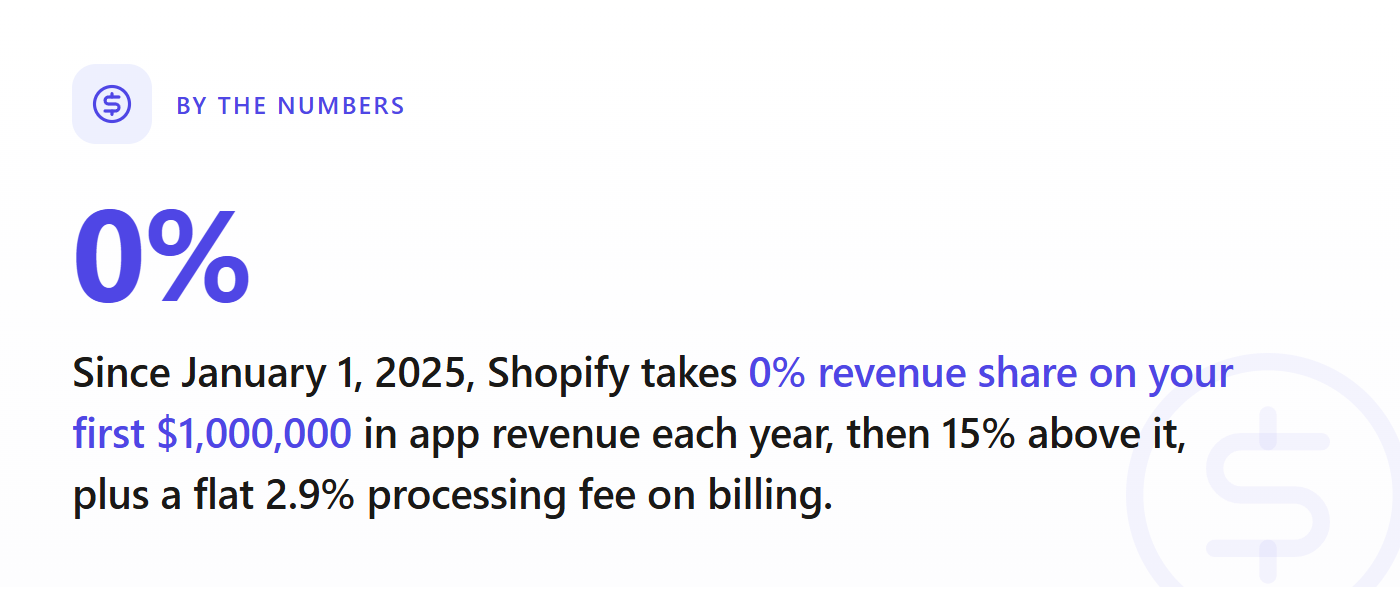
Since January 1, 2025, Shopify takes 0% of your first $1,000,000 USD in gross app revenue each year, then 15% above that, and every charge runs through a 2.9% processing fee. Add a one-time $19 to register as a Partner and that is the entire cost of selling an app on the Shopify App Store. For almost everyone reading this, the headline is simple: under $1M a year, you keep about 97 cents on every dollar.
The numbers, exactly
Here is the full fee structure, straight from Shopify's own revenue share documentation. No interpretation, just the facts you build your pricing on:
- $19 USD, one time, to create a Partner account. That is the only upfront cost.
- 0% revenue share on your first $1,000,000 USD in gross app revenue per year. This took effect on January 1, 2025. Before that the threshold was lower, so if you read an old guide quoting a $1M cutoff at 80/20, it is out of date.
- 15% revenue share above $1,000,000. The split only applies to the slice over a million; the first million is always yours in full. (Developers earning above $20M a year are on different terms, which is not the audience for this post.)
- 2.9% processing fee on all billing, plus applicable sales tax. This is the payment-processing cut Shopify charges on the money it collects through Shopify Billing on your behalf.
The thing worth saying plainly: this is one of the most generous app-store splits in software. Apple and Google take 15 to 30% from dollar one. Shopify takes nothing on your first million and then a smaller cut after. The platform is not where your margin goes.
A worked take-home example
Percentages are abstract, so let me run a real one. Say your app charges $13 a month and you have grown to 600 paying installs. That is $7,800 in monthly recurring revenue, or $93,600 a year gross.
You are well under the $1M threshold, so the revenue share is zero. The only deduction is the 2.9% processing fee:
- Gross monthly billing: $7,800
- 2.9% processing fee: $226
- You keep: $7,574 a month, about $90,888 a year
So on a sub-$1M app, your effective platform cost is just the 2.9% fee. Every $100 a merchant pays leaves you with roughly $97.10 before your own taxes. That is the number to plug into your pricing, your ad math, and your break-even, not a scary 20 or 30%.
What you keep at three revenue levels (annual)
Worked from Shopify's published rates: 0% on the first $1M, 15% above it, 2.9% processing on billing.
What it looks like once you cross $1M
Suppose a few good years later you are at $1,400,000 in annual gross app revenue. Now the split kicks in, but only on the part above a million:
- First $1,000,000: you keep 100% = $1,000,000
- Next $400,000: you keep 85% = $340,000
- Subtotal before processing: $1,340,000
- Then the 2.9% processing fee applies to billing across the board
Shopify's 15% touched $60,000 of a $1.4M business. The processing fee, not the revenue share, is still your larger line item until you are quite large. For most builders, the $1M cliff is a problem you would love to have, and even past it the platform stays cheap.
What the fees do and do not cover
A few things that trip people up when they model this:
- The 2.9% is Shopify's processing fee, not the merchant's card fee. It is the cut Shopify takes for collecting your subscription revenue through Shopify Billing. You are not separately paying Stripe on top for app charges billed this way.
- Sales tax is "applicable" and on top. Depending on the merchant's jurisdiction, tax may be added to what they pay; that is not your revenue and not part of your keep.
- There is no monthly platform fee and no listing fee. Unlike a lot of marketplaces, Shopify does not charge you to keep an app listed. Your recurring cost scales only with revenue.
- Free apps cost you nothing in revenue share (there is no revenue to share), which is part of why so much of the store is free. In our June 2026 scrape, 43.8% of the roughly 21,749 live apps offer a free plan or option.
One honest caveat on that last point: a free tier is cheap for Shopify to host but not free for you to support. The fee structure rewards charging; the 0% on the first million means a paid app keeps almost everything, so "go free to grow" is a marketing choice, not a fee-driven one.
So how should this change what you build?
The fee math has a quiet strategic message. Because the platform takes so little until $1M, your real constraints are not Shopify's cut. They are demand and competition: is there a market that will pay, and can you win a slice of it against the apps already there?
That is the expensive part to get wrong. Picking a category with no paying demand, or one where three entrenched apps own every install, will sink you long before revenue share ever matters. The fees are forgiving; the market is not. If you have not pressure-tested the niche yet, that is the work to do before you write code, and it pairs naturally with our piece on how to validate a Shopify app idea before you write any code and the read on the most saturated Shopify app categories in 2026.
We built the MetricHQ Market Validator to answer exactly that, niche by niche. Point it at a market and it reads the live App Store data: how many apps compete, how beatable the leaders are on rating, what share actually charges, and a revenue-versus-ad-spend projection with a real break-even, like the example above. The revenue share is the easy part of your model. Whether the market pays is the part worth checking first.
See whether your app niche actually pays
We scraped every app on the Shopify App Store. Check any niche for saturation, demand, and the gaps worth building, in seconds, before you write a line of code.
For the bigger picture on how fast the store is filling up, see our scrape of the whole Shopify app market.